

Review: The Price
[Marylebone Theatre || April 17th to June 21st 2026]

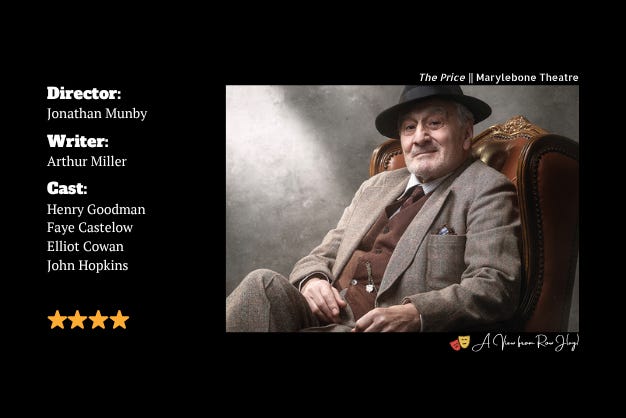
Has any American playwright better captured how the male descendants of the Great Depression lashed themselves so wholly and uncompromisingly to their own poisonous pride that it ultimately devoured them? Miller’s most famous tragic heroes - Eddie Carbone, Joe Keller and Willy Loman - are, above all else, felled by their own stubborn insistence that their honour is sacrosanct. As the survivors of a decade of penury, when working men like their own fathers were rendered jobless and penniless and left to wallow in the shame of their failure to provide for their families, they saw how men of honour and dignity were hurled upon and buried beneath the scrapheap. Honour thus became the only currency on which they knew they could rely, for it was the one thing that couldn't be stolen from them without a fight.
Though the dramatic structure and tone of The Price differs from those of All My Sons, Death of a Salesman and A View from the Bridge, the two brothers whose conflict forms the heart of the narrative could easily fit into any of those plays, for they too value honour at the expense of everything else, including their relationship with one another. Like the best of Miller's protagonists, both men are righteous to a fault and haunted by the spectre of a father who seemed to lose everything, including his self-respect, in the 30s. Accordingly, they are determined to never let such a fate befall them, yet it is in their very obstinacy that said fate appears inevitable.
The title alludes to the moral and ethical dilemmas that drive the narrative; in effect, what price do we pay for the decisions we make and the values we hold? Set entirely in an attic full of old family memorabilia and sentimental junk, it’s a work about how the young men of the thirties have become stuck in time, beholden to ghosts of the past whose memories they have purposely distorted in order to make their lives all the more bearable. Vic, a police officer who resents his lot and blames his older brother, Walter, whom he hasn’t seen in well over a decade, for, as he perceives things, abandoning him and his father at the height of the Depression, meets with Gregory Solomon, an 89-year-old antique dealer, so that he can finally be rid of all of his father’s things. After a lot of back and forth between Solomon and Vic, Walter arrives and all of the wounds of the past are ripped open once again.
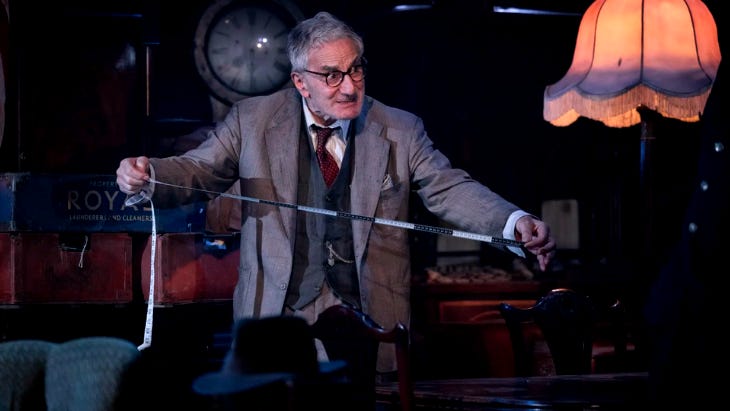
This is a strange text for Miller in that the first act is curiously light on substance, albeit intentionally so. There’s an element of farce to the proceedings as Solomon and Vic barter and haggle, often ineptly, while reminiscing about their lives through the hazy allure of nostalgia. Once Walter arrives however, the text becomes much more febrile and Miller finds himself very much in his comfort zone of angry, bitter men struggling to deal with all of the rage and regret that has been festering within them for decades. As the two brothers castigate each other for the slights they feel have been done to them, it becomes increasingly apparent that both men have created their own narratives of the past to justify to themselves how they exist in the present. Or, as Walter puts it: “we invent ourselves, Vic, to wipe out what we know.”
As with much of Miller’s work, the strength of The Price is in the dialogue which, though less poetic and rigorous than in his masterpieces, still bristles and rails against injustice and the poverty of a society that by 1968, with war waging in Vietnam and Nixon on the cusp of power, had become increasingly fractured by money. The parallels Miller draws between the misery of the 30s and the apparent recovery of the 60s imbue the text with a rage and a despondency that is well juxtaposed with the lightheartedness of the first act, and the claustrophobic setting, with the past towering over the characters and around an empty chair that could easily be filled with the ghost of the brothers’ father, creates a sense of real discord.
Extended for two weeks due to popular demand, The Price is the second of Miller’s lesser known texts to get a revival this year, following Jordan Fein’s production of Broken Glass at the Young Vic, which finished its run just over a month ago. Though Broken Glass was also a solid play, The Price feels closer to Miller at his most potent and profound. The performances are uniformly excellent and the messy set design creates a sense of disquiet that erupts into chaotic recriminations in second act, while Jonathan Munby’s direction leaves the actors ample room to properly become these broken characters.
Use the extra fortnight to see this if you can.
Tickets for The Price are available here.