

Review: Broken Glass
@ the Young Vic until April 18th 2026

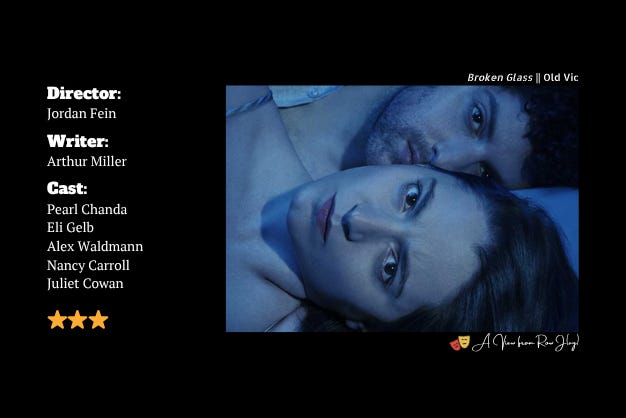
Brooklyn, 1938. Syliva Gellburg, an otherwise healthy Jewish woman, is suddenly and inexplicably paralysed from the waist down. She spends her days at home, anxiously obsessing over news stories about Kristallnacht and the ongoing persecution of Jews across the ocean. Meanwhile Phillip, her emotionally and sexually distant husband, employs the help of Dr. Harry Hyman, a fellow Jew, who theorises that Sylvia’s paralysis is not physical but rather psychosomatic and attempts to cure her on this basis. What follows is one of Miller’s most personal and self-reflective plays, in which he examines what it meant, and what it still means, to be a Jewish-American, with all of the complexities and contradictions entailed within such an identity.
Like most people, I associate Miller with the 40s and 50s. For me, it’s Marilyn Monroe, McCarthyism, and the eight-year period when he wrote his four great masterpieces: All My Sons, Death of a Salesman, The Crucible and A View from the Bridge. Though all of these works tackle, to varying degrees, ideas of fallen men, persecution, the complicity of bystanders and the immigrant / refugee experience, none are as explicitly about Jewishness or as autobiographical as Broken Glass, which was first performed in 1994 and feels like a late-life guttural exorcism for Miller. Indeed, early in the text, a reference is made to the dybbuk - a spirit from Jewish mythology believed to possess people - and Broken Glass can be interpreted as Miller’s attempt to expel his own, metaphorical dybbuk, which here manifests as a combination of shame and inadequacy.
There are lots of knotty ideas at work here, though the most profound, and certainly the most timely for this particular production, is the notion of Nazism as some paralysing contagion. Sylvia’s condition is an enigma, and no real closure is ever given with regards to its cause, yet it is clear she is morbidly terrified of the march of fascism across Germany and beyond. She is afraid also of Phillip’s apparent indifference to these events and of his desire to assimilate into middle class American society and to conceal, as much as possible, his Jewish identity, which she suggests renders him complicit and no different to the bystanders who watched as their Jewish neighbours had their livelihoods destroyed by looting mobs.
The extent to which Phillip is an avatar for Miller himself is debatable, but it is clear that the trope of the ‘self-hating Jew’ is more than just an archetype here. Phillip’s refusal to contend with what is happening in Germany, which to him is just so far away, feels a little like Miller reflecting on his own failures, and on the failures of the world in which he became famous and successful, to properly and proudly defend Jewish people and Jewishness. Though there are clear parallels in his previous works between, for example, the persecution of those in Salem and those in Nazi Germany, or between the experience of Marco and Rodolpho and the experience of Jewish people betrayed and abandoned by their own neighbours, this is the first text in which Miller is explicit and forthright about his Jewishness and his feelings about what happened.
As a result, Broken Glass lacks some of the poetic nuance and sophistication of Miller’s greatest works, in part because he uses the play to express something that has dwelled within him for almost eighty years. It isn’t subtle - though nor is the persecution against which he rails - and the dialogue is often blunt rather than sharp, but there’s still a fire and a rage to the text, particularly in the latter stages as Miller tries to unpick feelings of emasculation and inaction in a loveless marriage that resembles a microcosm of a much wider conflict between different Jewish people and identities. There is a delightful, low-level contempt for Hyman and his quasi-Freudian attempts to psychoanalyse Phillip and Sylvia’s sex life, and some great humour in Phillip’s tactlessness and desperation not to be perceived as one of those Jews, though the dialogue itself is, at times, also rather tactless and overwritten.
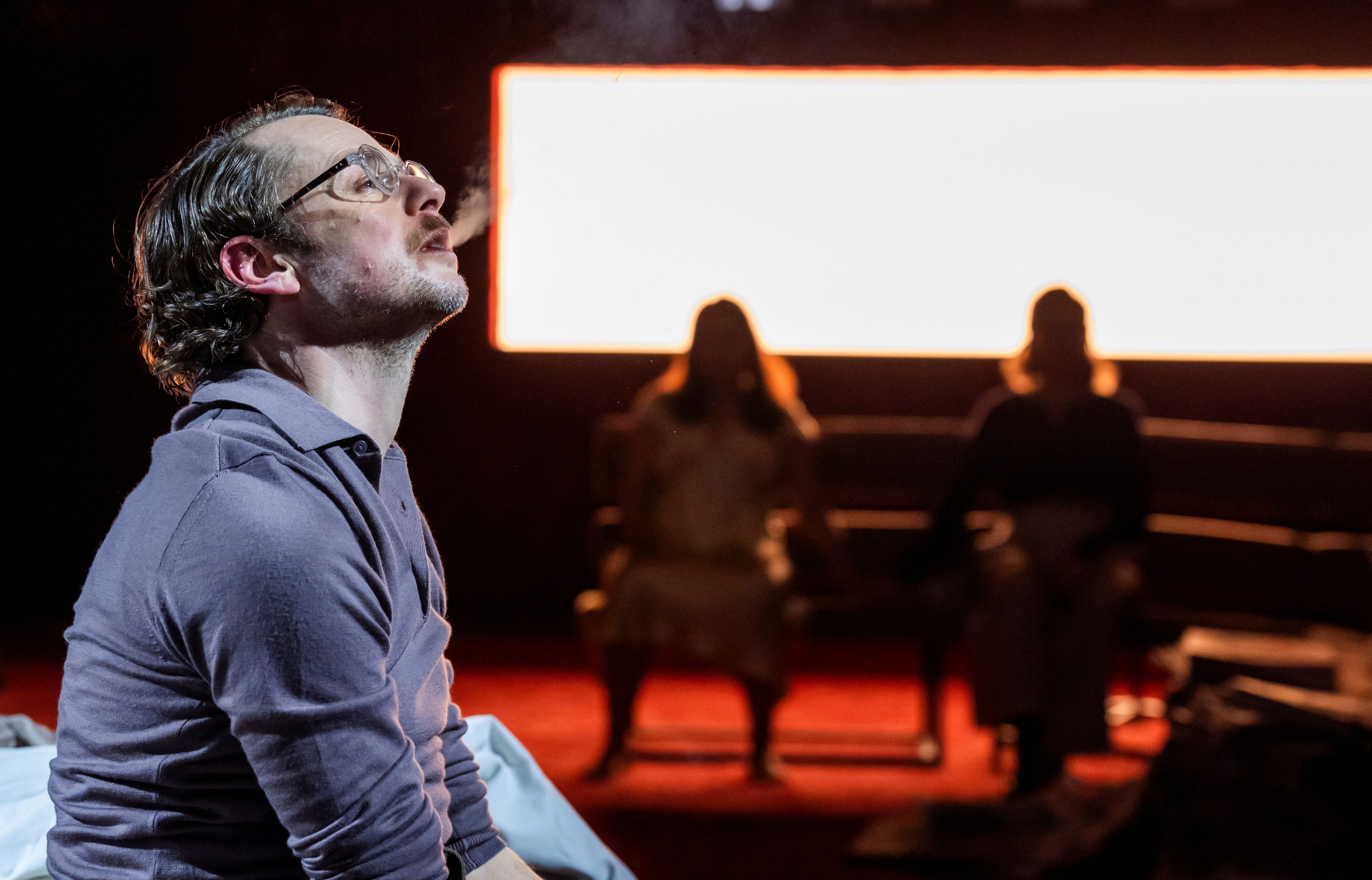
Stylistically, Jordan Fein’s production of the text is interesting. It runs for two hours without an interval, and much of the action takes place with the house lights up so that the audience is an active, complicit observer. The production is staged on a narrow thrust stage, as though the characters’ identities are under a microscope (there is even a goldfish in a bowl on the stage throughout, just to emphasise the point), while stacks of newspapers - some old, some modern - litter the sides. The back wall, meanwhile, resembles a thirties radio studio. The effect is to posit the characters, and Phillip in particular, who Eli Gelb plays, through his voice and mannerisms, as though he is a radio announcer, as people performing their Jewishness and trying to latch on to a firm identity of who and what they are.
Fein’s choices, however, don’t elevate the text - though nor do they detract from it - and there’s little sense of cohesive stylisation here, so the occasionally leaden dialogue is left to do most of the work. The performances are decent - Pearl Chanda is very good - though the decision for Phillip to enunciate the way he does is a little strange, as his style doesn’t change in conjunction with his character, and although the production has a quite fiery energy, at two hours without an interval it does occasionally sag. There are issues with pacing, too, with an overload of exposition at the expense of the more human drama that comprises the latter stretches of the play.
Broken Glass is far from seminal Miller but it’s still a curious piece with lots of ideas bubbling away beneath the surface, albeit ones that sometimes feel disparate from one another. Fein’s production is solidly entertaining and piques the audience’s interest with its stark staging, and it is fascinating to see Miller try to unpick his own identity. For its faults, it’s still a piece with some beautiful lines about the nature of prejudice and the inefficacy of man in the face of his own mortality, and I’m pleased to see a theatre like the Young Vic stage it, if only so everyone gets to experience even more of Miller’s wit and insight about the world we’re still living in today.