

Review: One Flew Over the Cuckoo's Nest
[Old Vic || April 1st to May 23rd 2026]

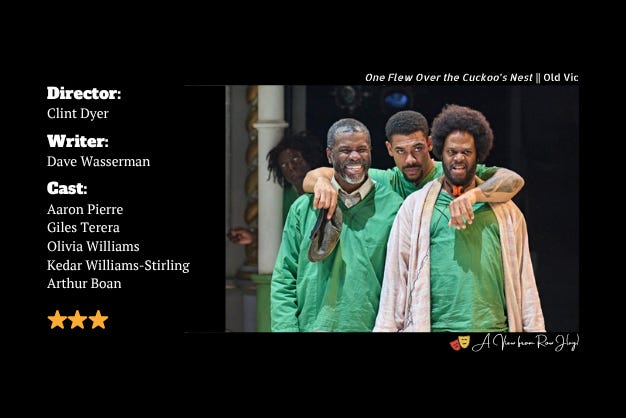
One Flew Over the Cuckoo’s Nest, Ken Kesey’s dual critique of psychiatry and institutionalisation and searing celebration of the rebel, is known best thanks to Miloš Forman’s 1975 film of the same name, though it was actually adapted for the stage by Dave Wasserman some twelve years prior. While undoubtedly dated in both their language and their portrayal of mental illness, Kesey’s novel, Wasserman’s stage play and Forman’s film all share an easy affinity with the story’s antihero, Randle McMurphy, an in-patient who feigns insanity to avoid prison. Conversely, they also all share a disdain for the authoritarianism represented by Nurse Ratched, the woman who runs the ward on which McMurphy is incarcerated and whose name has since become a byword for medical malpractice and institutional cruelty as inflicted by a woman.
Woven into the DNA of the novel, play and film is a thesis on power. There is the institutional and judicial power of course, which allows people to be interned, experimented on and branded with the various labels of mental illness because they do not conform to arbitrary norms imposed upon them by a society rigidly organised into social hierarchies. Then, there is the power of these hierarchies themselves - of sex, gender, physical strength, mental resilience, and so on - and how these become distorted on the ward, precisely because the characters have been removed from the society within which these hierarchies function. Ratched, a woman, is able to assert absolute dominance and authority over a ward of men, some of whom are there voluntarily, thus willingly sacrificing their place in the hierarchy, because the traditional power dynamics do not apply.
Clint Dyer, whose Death of England trilogy stands out as one of theatre’s better post-Brexit (absolute) state-of-the-nation offerings, a directs a revival that considers an additional power dynamic that further complicates the relationship between the characters: that of race. Ratched’s whiteness stands in contrast with her patients, all of whom are BIPOC men, and her actions and demeanour towards McMurphy in particular become tinged with racial prejudice. Except, alas, Dyer doesn’t do much with this dynamic. The text is mostly unchanged, and though there are hints in the production of the parallels between institutionalisation and slavery and while he embeds some visual references to what freedom looks like specifically for BIPOC men into the piece, it feels like a missed opportunity to explore this story through a unique lens.

Somewhat diminished too is the suffocating sense of containment and claustrophobia integral to a story like this. For what appear to be economic reasons - the show only runs for seven weeks - the in-the-round staging of Arcadia has been maintained (and will also be for the upcoming Glengarry Glen Ross, I suspect), with characters free to enter and exit the stage as required. Were they kettled on stage and thus trapped beneath the glare of the audience Panopticon, this might have been effective but the characters have far too much freedom to move about, which undermines the idea that they have been deprived of agency. The use of staircases and balconies on either side of the stage does effectively mirror the amorphous hierarchies on the ward, however, and the use - or rather misuse - of the floor in the final scene enhances what is already a moment of quite intense catharsis.
The ensemble, led by a captivating Aaron Pierre, who brings a flirtatious, calculating menace to McMurphy, is very strong, with Kedar Williams-Stirling proving especially impressive as young inmate Billy. Olivia Williams, stepping in at short notice to replace Michelle Gomez, who had to leave the show during rehearsals, doesn’t quite have the forcefulness or presence to capture Ratched’s deviousness, playing her as a little too flustered, but she is competent enough. She never matches Pierre’s frenzied energy, however, so the key moments of conflict between the two characters aren’t as impactful as they should be. Nonetheless, the performances across the board and decent and each actor manages the balance of dark humour and harsh drama with considerable skill.
All in all, this is a functional and entertaining production of a well-known story that lands most of its emotional beats and is punchily directed by Dyer. It does feel like an opportunity to dig deeper into the story’s interplay of race, sex and mental illness has been squandered but, thanks to Pierre’s effortless stage presence and some tightly choreographed sequences of rage, it’s also an often cogent watch. It’s a shame Gomez wasn’t able to do it, as I suspect her Nurse Ratched would have been exemplary, but this is still worth seeing, if only for Aaron Pierre’s delicious take on McMurphy.
Tickets for One Flew Over the Cuckoo’s Nest are available here.