

Review: Arcadia
[Old Vic || January 24th to March 21st 2026]

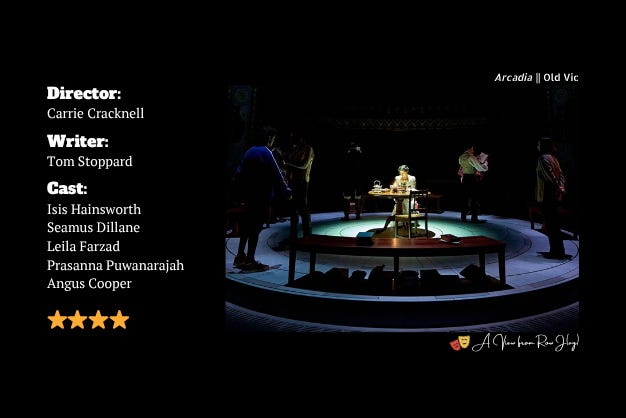
Though he penned, even at the most conservative estimate, at least half-a-dozen bona fide masterpieces in his time, when Stoppard died in November one work in particular was referenced and fondly remembered in obituary after obituary: Arcadia. Indeed, so influential was Stoppard’s 1993 modern classic that Michael Baum, Professor Emeritus of Surgery at University College London and one of the country’s leading breast cancer specialists, credits his seeing the play, and its examination of chaos theory, as a critical factor in the advent of “adjuvant systemic chemotherapy”, which has since saved countless lives right across the world. Quite the legacy, eh?
Last staged in London in 2009 at the Duke of York’s, starring Samantha Bond and Dan Stevens, Arcadia is one of Stoppard’s most philosophical, profound and rarely produced plays. Carrie Cracknell’s production at the Old Vic was announced in October, just a month before Stoppard’s death, and it feels apt that, with the exception of Indian Ink at Hampstead Theatre, the first major posthumous production of his work is of one of his most celebrated and complex pieces. Poetic, romantic but rigorous, it is a work about the relationships and conflicts between order and chaos, free will and determinism, science and art, and life and death. However, like so much of Stoppard’s work, all of these grand ideas and concepts are mere vessels through which he can explore the most abstract, metaphysical riddle of all: the relationships and conflicts between people in love.
Set in the same manor house across two different timelines two centuries apart, Arcadia centres on academics in the present day studying the history of the manor, its inhabitants and its guests, many of whom we observe locked in fierce debates about poetry, philosophy, religion and mathematics in the early 19th century. Threaded through the different narratives and timelines are recurrent motifs of sex and love, both of which threaten to destabilise everybody’s preconceived notions of how the universe operates, with nobody spared from the consequences of “the attraction that Newton left out”. As is customary with Stoppard’s plays, the dialogue is sagacious - sometimes overwhelmingly and bafflingly so - and compelling, which allows all of these dichotomies, most of which modern playwrights wouldn’t dare tackle independently, never mind collectively, to dazzle.
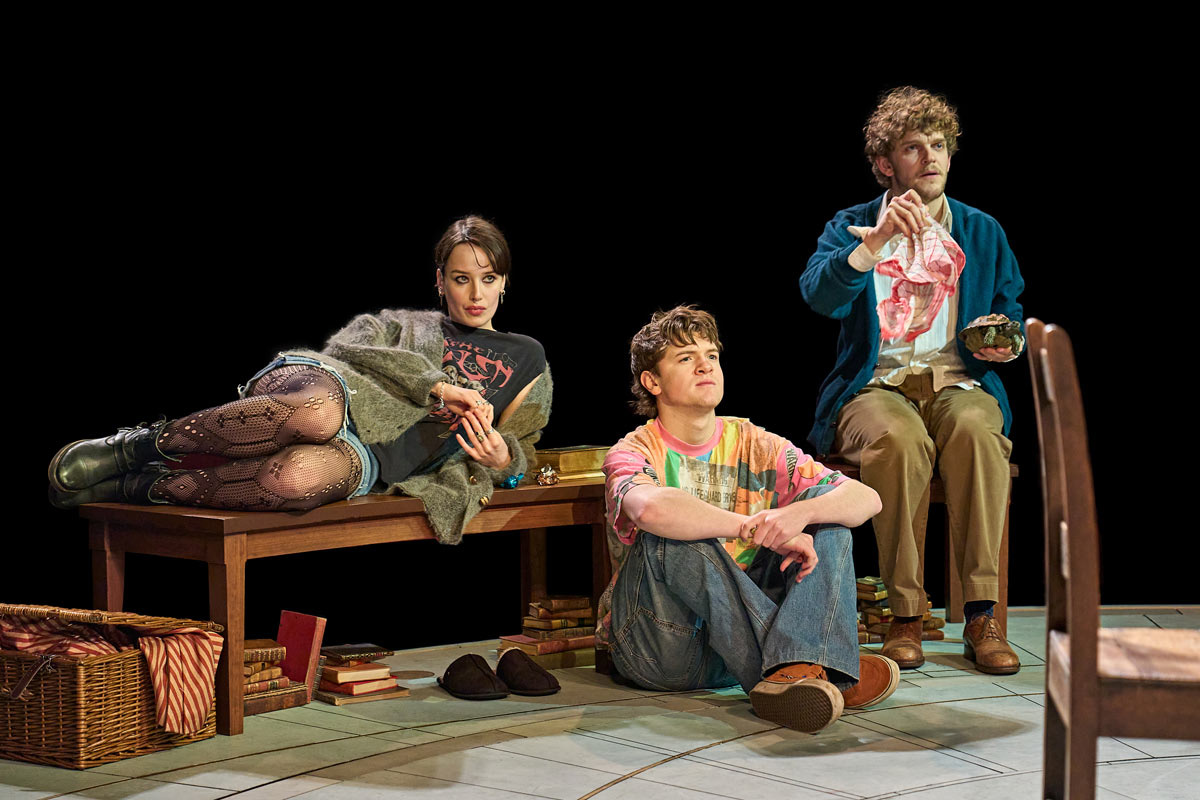
In the past, we follow the precocious, intellectual daughter of aristocrat Lady Croom, Thomasina Coverley, who, under the tutelage of Septimus Hodge, demonstrates an astute capacity for mathematical analysis that far exceeds that of her elders. Septimus, meanwhile, has been caught in a “carnal embrace” with the wife of a rival, the unsuccessful poet Ezra Chater, whose work Lord Byron - regularly mentioned but never seen - derides. In the present meanwhile, Hannah Jarvis, an academic studying Lady Caroline Lamb, Byron’s mistress, conducts research into an elusive hermit who resided in the grounds of the manor in the early 19th century. When not clashing with Professor Nightingale, who is also at the manor trying to prove that Byron duelled with and ultimately killed Ezra, she and Valentine Coverley, a mathematics graduate and descendant of Lady Croom, become engrossed in the mystery of Thomasina’s scribblings.
Written in two acts, each scene shifts from past to present and back again, slowly revealing pockets of truth to both the audience and the characters, until the final scene blends the two worlds together, the barriers between them collapsing into a chaos that paradoxically precipitates order as the events of the past impact those some two hundred years later. Props and artefacts from the past litter the stage of the present, their contexts and meanings sometimes misconstrued, while the scientific knowledge and insight of the present manifests itself in the past, not fully or sometimes even remotely understood but nonetheless pivotal to how the characters think and behave. Indeed, as Valentine states in the present:
“It’s the best possible time to be alive, when almost everything you thought you knew is wrong.”
This aphorism applies equally to characters in both timelines. Their understanding, or lack thereof, of the world is shaped by what came before, and what came before seems ignorant and primitive to them. Yet as the drama progresses, Stoppard ponders how the influence of the past shapes the present and how accepted contemporary ideas must have existed in the past, doing so through the dual lenses of chaos theory and the theory of thermodynamic equilibrium, which posits that the ultimate fate of the universe is its “heat death”. Safe to say, it’s not a text for those looking to switch off at the theatre…
Cracknell’s production of this knotty text dispenses with the pomp and grandeur of the manor in which it is set, instead being staged in the round upon a perfect circle that is patterned with a geometric design and slowly rotates, at once suggesting finality and infinity. Lit from above by twenty orbs and two ellipses, it has a magical, mystical quality to it that heightens all of the intimacy and profundity of Stoppard’s text. Characters move on to and off the stage as though visitors from another time or place, the choreography reminiscent of a beautiful dance, occasionally appearing to stumble into the wrong era, while one - Gus / Augustus - serves as a bridge between the two.
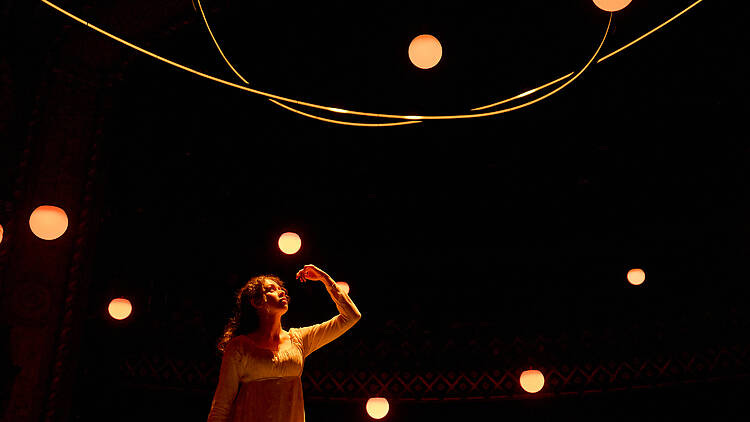
So much of the play’s success rests on the extent to which we believe in its verbose and querulous characters, who talk in metaphors yet constantly seem unable to express their true feelings. Thankfully, the performances are uniformly strong, and so it is easy for us to invest in these people. Though Stoppard’s script has a tendency to resort to monologues and lectures, these never feel out of character; indeed, it is easy to imagine such people getting into ferocious arguments about the nature of existence. Particular mention must go to Isis Hainsworth, who captures all of Thomasina’s intelligence and yearning so beautifully, and also to Prasanna Puwanarajah, who is perfectly insufferable as the egotistical Nightingale.
There’s no denying that, at three hours long, Arcadia is a little flabby, and there are occasional lulls in the drama that undermine its momentum. Nonetheless, Cracknell’s production is a minor marvel, full of affection for the material, and everyone involved does justice to Stoppard, who would no doubt have loved this staging. At its best, it is a soaring, swirling romance that has an intimate understanding of human relationships, and is so unapologetically intellectual and forensic in its study of what it means to live and to die in a world as predictably chaotic and chaotically unpredictable as our own.