

Review: Black Comedy
[Orange Tree Theatre || May 16th to July 11th 2026 || 1h 15m]

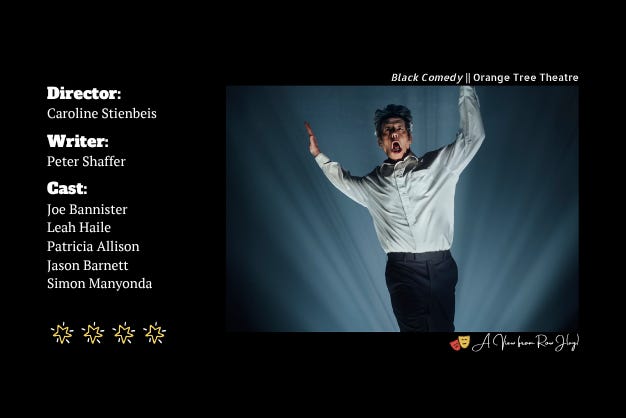
This year marks the centenary of Peter Shaffer’s birth - indeed, Black Comedy opened the day after what would’ve been his 100th birthday - and he’s quite rightly being celebrated. Though he wrote relatively few plays in his 90 years, he nonetheless had a profound and lasting impact on British theatre, writing not one but two of the greatest dramas of the 20th century: Equus, which is currently halfway through a staggering revival run at the Menier Chocolate Factory, and Amadeus, which is due to be adapted by Jeremy Herrin with Michael Sheen and Callum Scott Howells as Salieri and Mozart next year. However, before either of these were even a scribbled idea in the corner of a page of a scrapbook, there was Black Comedy, a 1965 farce so far removed from the style and tone of his two great dramas that it’s hard to believe they were all written by the same man.
And yet all of Shaffer’s ingenuity and experimentation, not to mention his desire to subvert theatrical conventions, are as apparent here as they are in his other works, and you can see the seeds of the writer he would soon become. The title itself is a pun on the play’s use of light and its absence as Shaffer constructs a scenario in which the characters spend much of their time in total darkness - initially accidentally and then, as the farce becomes ever more chaotic, by design - with the actors forced to behave as though they cannot see each other or their surroundings for much of the runtime. To achieve this, Shaffer instructs the director to stage the start of the play, when the characters can see each other, in actual darkness, so that light becomes its absence and vice versa. When the lights are up, we can see the characters but they are blind; when they are down, the reverse is true.
It’s a nifty concept that allows for a meticulously choreographed style of slapstick that nonetheless feels organic and improvised. Characters flail about, grabbing each other, bumping into things, falling down, mistaking each other for someone else and a whole host of other shenanigans and mischief, but Shaffer makes it work because there is always a logical reason for the characters to remain in the dark. When light is introduced in the form of lighters, matches and torches, the protagonist must snuff it out in order to maintain all of the illusions and lies that must not have light shone upon them, lest the facade crumbles. It’s dramatic irony turned up to eleven; we can see it all, we can anticipate calamities before they happen, and it makes it all the funnier.
In the intimate space of the Orange Tree, director Caroline Steinbeis does excellent work keeping all of the plates spinning as the pace of the narrative becomes ever quicker and more frenzied. The Rube Goldberg-esque nature of it all doesn’t leave her with much room for manouevre, yet she handles it with a remarkable level of control that is also evident in the performances. Bannister is all gangly limbs and exaggerated expressions, yet he doesn’t put a foot wrong; or rather, he puts many feet wrong, exactly as planned. Though his character is the sculptor (literally, for that is his job) of his own pandemonium and is revealed at various points to be a thief, a cheat and a liar, Bannister is able to make us sympathise with the ludicrous situation in which he has become embroiled.
The rest of the cast are excellent too, and though Bannister is the lead it is very much an ensemble piece that requires everyone to be operating on the same ridiculous level. The humour wouldn’t be half as effective as it is were the actors not at the top of their game, and they all embrace the madness of Shaffer’s text with an infectious playfulness. The result is a production that is consistently laugh-out-funny with no pretentions about what it is. That the dialogue still has a richness and poetic lightness to it is mere adornment on what is a fabulous production.
Tickets for Black Comedy are available here.