

Review: Equus
[Menier Chocolate Factory || May 8th to July 4th 2026]

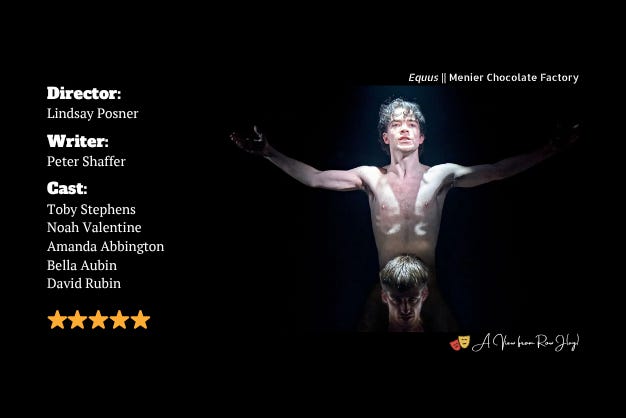
Note: This review contains some minor spoilers about what ‘Equus’ is in the context of the play
The reputation of Equus, Peter Shaffer’s controversial 1973 play about child psychiatrist Dr. Martin Dysart and his attempts to treat 17-year-old (un)stable boy Alan Strang who, in an act of apparently inexplicable and random violence, has blinded six horses with a hoof pick, precedes it. Perhaps best known for the physical vulnerability and emotional intensity required by the young man playing Alan, the text’s most famous London revival in recent years was at the almost thousand seater Gielgud Theatre and starred Daniel Radcliffe in his first major non-Harry Potter role. Now, almost twenty years later, the play returns for a limited run at the much smaller and more intimate Menier Chocolate Factory, starring Toby Stephens as Dysart and relative unknown Noah Valentine as Alan.
The central focus of Shaffer’s text is on the relationship between Dysart, who is disillusioned with the nature of his work, and Alan, who appears resistant, at least initially, to Dysart’s attempts to psychoanalyse him. As the narrative progresses it becomes clear that Alan is fettered in some bizarre master-servant relationship with horses, whom he appears to worship as gods. Instructed to alleviate Alan’s “pain”, Dysart attempts to uncover the cause of Alan’s delusion and the catalyst for his subsequent actions in order to cure him, only to conclude that in removing said pain he will also render him hollow because his pain is inextricably linked to the passion and desire to worship that caused him to behave as he did. In effect, one cannot exist without the other. As Dysart rages:
“He’ll be delivered from madness. What then? He’ll feel himself acceptable! What then? Do you think feelings like his can be simply reattached like plasters? Stuck onto other objects we select? Look at him! My desire might be to make this boy an ardent husband, a caring citizen, a worshipper of an abstract and unifying God. My achievement, however, is more likely to make a ghost.”
The morals and ethics of “curing” Alan form the emotional and thematic thrust of the text, though this debate constitutes just one part of its rich tapestry of complex and conflicting ideas. In many ways, the play is reminiscent of one of Shaffer’s other great masterpieces, Amadeus, in that it wrestles with religion, guilt, sexual repression and desire, shame and inadequacy, all of which are manifested in the concept of the titular ‘Equus’, the perverse deity to whom Alan is so subservient. All of these ideas and feelings, alongside the sense that in order to be healthy and worthy of society’s tolerance we must suppress our emotions and needs, also represent the conformity and normality anathema to Alan’s passion, which Dysart finds so compelling and attractive.
The value of the intimate space in exploring and navigating such an intricate text cannot be overstated. The play’s intensity, which tightens around the audience like a noose about the neck of the damned, is exacerbated by the claustrophobia of the space. Norms abrade right before our eyes, as though we are complicit and involved in the drama. Indeed, with the notable and obvious exceptions of Alan and Dysart, all of the characters sit in the front row on all three sides of the thrust stage when not interacting with the two leads, emphasising how both we and they bear at least some of the blame and responsibility for what has occurred.
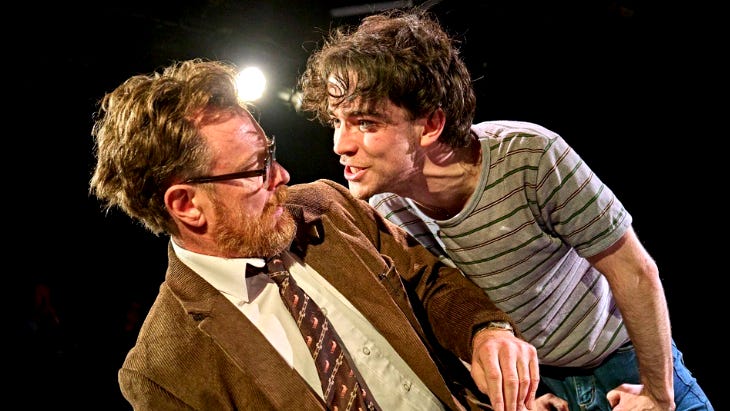
Likewise, the sparseness of the set, which appears to merge with the back wall and, in turn, the ceiling, is used to exquisite effect and draws all of our attention to the characters. Paul Pyant’s lighting and Adam Cork’s sound design are atmospheric and deeply unsettling, heightening the play’s already ferocious emotions and creating a sense that something truly subversive and unnatural is unfolding in front of and around us. This is true also of the six ensemble members who perform as the horses and whose physicality and choreography is contorted and twisted, as though they comprise some Eldritch nightmare that recalls the sequence in Macbeth when Duncan’s horses become frenzied and start devouring each other.
Posner’s direction is majestic and he punctuates this production with some truly remarkable sequences. The conclusion to the first act, in which Alan’s relationship with the horses and the sheer monstrousness of his delusions become apparent, is breathtaking (literally, I felt my breath stall) while the moment of violence when Alan blinds the horses unfurls like a deviant ballet that inflames the senses and leaves the audience in a state of mania. Yet these sequences wouldn’t be anywhere near as effective were Posner’s command of the production in its quieter moments not also as thorough and intelligent as it is. He is often restrained and allows his stars to immerse themselves in these characters of their own accord, which further amplifies the emotional forcefulness of their interactions.
And it’s the stars who make this such a miraculous revival. Valentine, in what is only his second appearance on stage after starring in Noughts and Crosses at Regent’s Park Open Air Theatre last year, is courageous, vulnerable and captivating, and he embraces this role like a man possessed, while Stephens expertly captures all of Dysart’s spiralling desperation and dissatisfaction. Between them, they enhance and elicit all of the layers and complexities of their relationship. As it becomes clear that Dysart can ultimately only help Alan by extinguishing his very essence - as he tells his broken patient, “when Equus leaves, if he leaves at all, it will be with your intestines in his teeth” - the two of them do phenomenal work in enhancing how tragic this fate will ultimately prove to be.
This is one of the best productions of the year so far. It’s febrile and incendiary and riveting, unfolding like an exorcism of something primal. Posner’s direction, the performances of Stephens and Valentine, and the design of the set, the lighting and the sound all contribute to a revival that is potent and robust and has a sophisticated understanding of how to disentangle Shaffer’s rigorous text. Do whatever it takes to get a ticket.
Tickets for Equus are available here. The show is also transferring to the Theatre Royal Bath for a two-week run in July.