

Review: Archduke
[Jerwood Theatre Downstairs at the Royal Court || June 20th to July 25th 2026 || 2h]

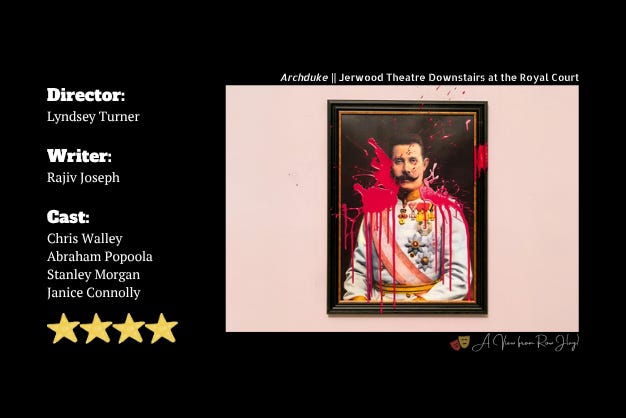
What drives a person to assassinate another? It has become a question of some renewed urgency in Britain in the past week1, though history is littered with acts of political murder - Caesar in 44BC, Abraham Lincoln in 1865, Mahatma Gandhi in 1948, and so forth - many of which have proven to be definitive moments in our collective story. Few of these assassinations, however, has been as consequential as that of Archduke Franz Ferdinand of Austro-Hungary, who was shot by Serbian nationalist Gavrilo Princip on June 28th 1914. A month later, the ironically named “Great War” broke out and, over the course of the next four years, somewhere in the region of 20 million people lost their lives. Two decades of further upheaval followed, ultimately plunging the world into a further conflict that would claim the lives of another 75 to 85 million people.
Of course, the causes of both wars are complex and multifaceted, and nobody is for one moment suggesting that the assassination of one man was the sole catalyst for the subsequent deaths of a further 100+ million. However, these pinch points in our history, when the entire world seemed to pivot on its axis and change forever in an instant, are ripe for dramatic exploration (“what if…?” is one of the most regular questions in literature) and that is what writer Rajiv Joseph, whose 2010 play Bengal Tiger at the Baghdad Zoo recently received its European premiere at the Young Vic, seeks to do here. He isn’t interested in retreading and retelling the story of Franz Ferdinand’s assassination, which is one of historical record, but rather in using said assassination as a narrative hook to explore issues of radicalisation and disaffection that are as pertinent in 2026 as they have ever been.
In many ways, this is a brave exercise. To take a moment of such consequence and to not just dramatise but recontextualise and “edit” it in order to explore different ideas entirely takes real skill and a deftness of both humour and seriousness, and Joseph’s script, though occasionally a little blunt with its parallels and allusions to the modern world, does all of this with some considerable success. Set in the days leading to the assassination, his play posits that Princip and the other would-be assassins, all of whom are starving and dying from Tuberculosis, are motivated not by a desire for Serbian unification, or any political principle or agenda at all really, but rather by the honour, glory and, indeed, food promised to them by Dragutin Dimitrijević, the charismatic leader of the group responsible for killing Ferdinand.
Parallels between Dimitrijević and the toxic male influencers of the Manosphere are drawn throughout the piece, with Joseph focusing on the emotional exploitation of those already exploited by an economic and political system that ignores them at best and actively denigrates them at worst. The would-be assassins’ reluctance to kill the Archduke’s wife Sophie as part of the operation leads to a discussion about how women are blamed for the problems of young men, while a motif of transient, elusive witchcraft permeates the text, as though the boys chosen for the great mission are being dissuaded from it by the spiritual realm, which allows for Dimitrijević to further exploit the boys’ sense of isolation.
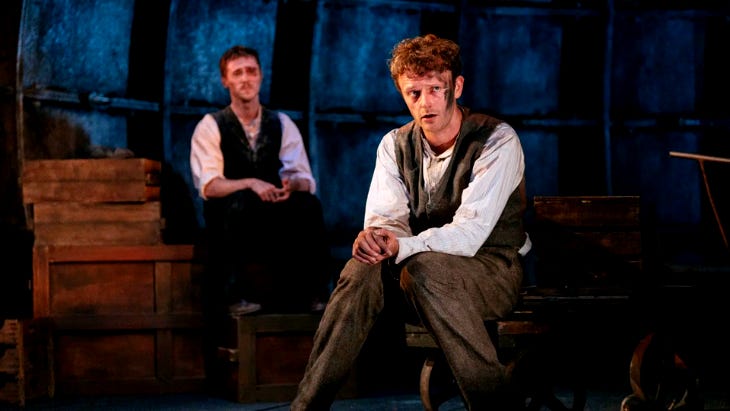
Es Devlin’s clever set design likewise heightens the sense of isolation and claustrophobia that these young men feel. The stage resembles a cold, metallic tunnel that faces outwards to the audience and serves as a bunker and a church and later facilitates the arrival of a train carriage on rails. Mirroring the drama, the staging is dark and sometimes obscured by a bend in the tunnel that hides secrets and blocks our view of key moments of conflict, hinting at the fuzzy patchwork of history and how our perspective can be tainted. Lyndsey Turner’s direction, which plays with the space and sometimes reduces it to what feels like the tiniest of rooms, likewise well mirrors the psychological loneliness and entrapment of the men.
Perhaps most impressive about Archduke, however, is how Joseph seamlessly weaves dry comedy into what is ultimately a play about the events leading to the calamitous First World War. The dialogue is quick and witty and the interactions between Dimitrijević, his cook Sladjana (the only woman in the play and the only one who can foresee the misery the assassination will cause) and the three potential assassins are rich with humour, even as they discuss committing an act of terror on the streets of Sarajevo. Accordingly, the interweaving of contemporary issues into a play set over a century ago feels natural.
Also noteworthy are the performances, particularly of Marc Wootoon (best known, amazingly, as Mr Poppy in the Nativity! films…) as Dimitrijević and Janice Connolly as Sladjana, who has arguably the most part to play in that she is the main comic relief but also the conscience of the piece. Wootoon’s Dimitrijević is delightfully crazed but also, like so many of the influencers to whom young men have lost their critical faculties, horribly compelling and convincing, and as he exploits the young men’s hunger, their poverty and their sense of rage with their lot, he becomes all the more persuasive. The three assassins also do stellar work capturing the emotional turmoil and weight of legacy placed upon their youthful, naive shoulders.
Archduke is yet another example of what the Royal Court does so well: fresh, exciting new dramas with something insightful to say about the world in which we currently live. Though it isn’t quite as accomplished as their two other European premieres this year - Guess How Much I Love You? and John Proctor is the Villain - it’s an entertaining and brilliantly directed bit of theatre that wrestles with grand ideas and isn’t afraid of confronting their complexities or the vastness of history more generally. If you’re able to get a ticket, it is well worth a look.
Tickets for Archduke are available here.