

Review: John Proctor is the Villain
[Jerwood Theatre Downstairs at the Royal Court || March 20th to April 25th 2026]

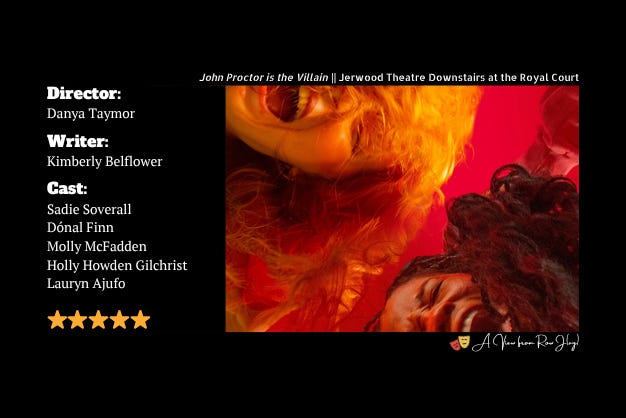
John Proctor is the Villain’s reputation precedes it and then some. Its exponential growth in popularity and acclaim over the past four years has been remarkable: from humble beginnings at the Studio Theatre in Washington D.C., it soon transferred to Boston and then Broadway, where it featured Sadie Sink (presently starring in Robert Icke’s adaptation of Romeo & Juliet) and received seven Tony Award nominations. It is currently in its final week at the Royal Court in London, where it forms part of the theatre’s impressive 70th anniversary season. A 12-week transfer to the West End has already been announced for 2027 too, so it’s showing no sign of slowing down just yet.
Now, the name John Proctor will be familiar to anyone who knows, or even has a tangential awareness of, Arthur Miller’s seminal and divine indictment of McCarthyism, The Crucible. For decades, students right across the globe have read and analysed and reanalysed and overanalysed the play, and it is generally considered (rightly, in my view) to be one of the greatest dramas of the 20th century. In the text itself, Proctor, who is very much an avatar for Miller, refuses to succumb to the madness of the witch trials around which the plot unfolds or to sign a false confession, instead opting to be hanged; in other words, he is the undisputed hero - albeit a tragic one, as most of Miller’s are - of the piece… right?
Wrong!
Well, at least according to Kimberly Belflower’s electrifying and riveting interpretation of the text anyway. Told through the lens of high schoolers no older than Abigail Williams is in Miller’s text, John Proctor is the Villain uses a discussion about Proctor’s character flaws as a catalyst to explore sisterhood, feminism, sexual politics, assault, the justice system, grooming, education and so much more. Throughout, Belflower remains conscious of the parallels between her work and Miller’s, both stylistically and in terms of content, but is never beholden to them, instead crafting a text that is uproarious and uplifting with a real richness and complexity of its own.
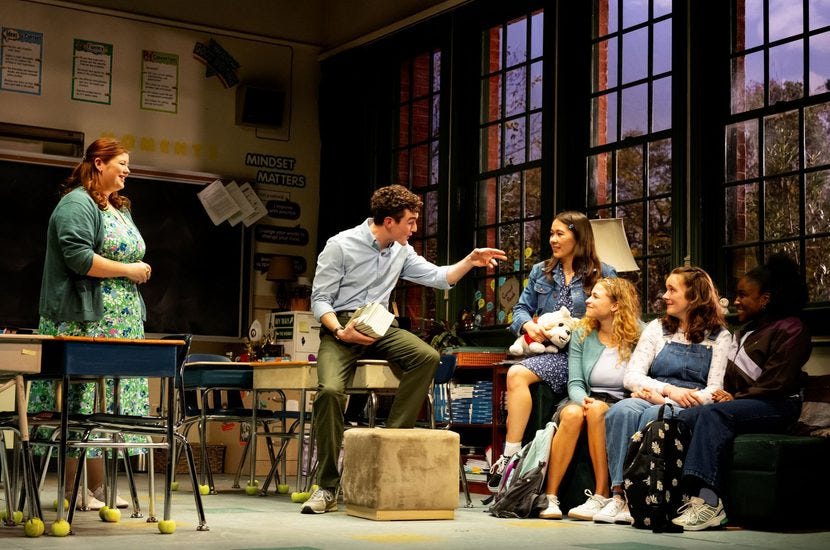
Plays about plays - though as already stated, John Proctor is the Villain is so much more than that - are a little like movies about movies in that there’s often a tendency towards pretention, in-jokes and self-satisfaction. John Proctor is the Villain avoids almost all of these pitfalls because it is really no more about The Crucible than The Crucible is about the Salem witch trials. Both texts are allegories about something much more urgent and contemporary; John Proctor is the Villain is just the next link in this allegorical chain, and there’s an inherent pressure in being so - after all, Belflower is essentially slaughtering a sacred cow on stage - but it’s a pressure that the text relishes.
However, this isn’t a literature essay, it’s a play, and so what matters most is the extent to which Belflower and director Danya Taymor (who also directed the show on Broadway) are able to use the form to create drama, tension and humour. In this respect, their play is a triumph; the writing is perceptive and intelligent, with some remarkable character work that captures all of the contradictory anxiety and confusion of girlhood while also being delightfully funny. The script has a thrilling bouyancy to it that allows it to traverse that finest of lines between comedy and tragedy, and it never surrenders to oversimplification or eschews a challenge.
It’s also subtle, not necessarily as an allegory - John Proctor’s name is in the title, it’s not meant to be a subtle allegory - but in how all the quiet moments of unease, rage, fear, hope, friendship, betrayal and disbelief are handled, and so much of this is down to the note-perfect performances and Taymor’s clever but unobtrusive direction. The representation and portrayal of these teenage girls isn’t just authentic, it’s also empowering in a way that feels true to who these characters are. The development of each character feels genuine because Belflower respects them as people and Taymor and her cast do such excellent work in getting to the heart of them.
Towards the end of the play, I was reminded of a quote often attributed to Emma Goldman:
“A revolution without dancing is not a revolution worth having.”
John Proctor is the Villain feels like a revolution with dancing, and one that must be had. It’s a guttural scream against the abuse of young women, sure, but it’s also a joyous tale of female friendship and solidarity that is wickedly entertaining and brimming with a depth and insight that crescendoes in one of the most spectacular final scenes I have seen in some time. Believe the hype. This is a superb play and you must rush to see it when it transfers next year.