

Review: Under the Shadow
[Almeida Theatre || June 2nd to July 4th 2026 || 2h 15m]

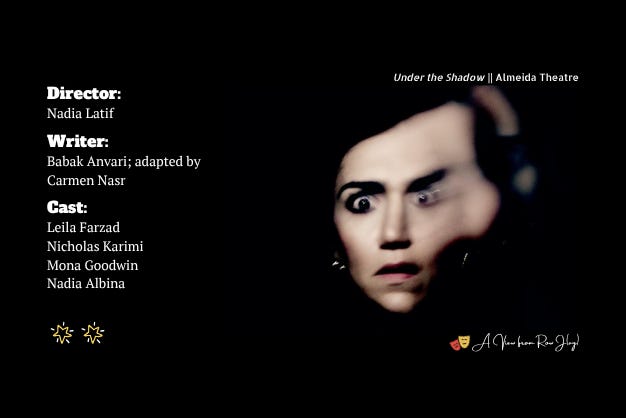
Another week, another stage adaptation of a feature film. Whilst we’re not quite at the level of Before I Go To Sleep or The Housemaid just yet - though both of these are alas very firmly on the horizon - the decision to adapt Babak Anvari’s Persian-language horror film Under the Shadow, which was released to great critical acclaim a decade ago, is one that feels both unnecessary and entirely arbitrary, even when one considers the parallels between the source material and the various wars, conflicts and genocides currently tearing through vast swathes of the Middle East. The further decision to take a text that is rooted in both cultural and geographical specificity and translate it into English for an audience of predominantly white liberals at the Almeida in Islington is all the more bizarre still.
Set in Tehran in the mid-to-late 80s, in the aftermath of the Iranian Revolution and at the height of the Iran-Iraq War, Under the Shadow unfolds almost entirely within one apartment block in the city. Shideh, a former leftist activist and medical student who has been barred from completing her studies as a result of her politics, lives with her husband, Iraj, and their young daughter, Dorsa. As the war wages and the danger of Saddam’s onslaught on the country draws ever closer, Iraj pleads for Shideh to agree to leave the city. Dorsa, meanwhile, becomes increasingly convinced that their apartment is being haunted by the Djinn, mythological creatures in Arabian and Islamic folklore who possess people’s spirits and steal from them.
The allegory of the Djinn as representative of the new Iranian regime, with its omnipresent parasitism that coerces and terrorises women and children into submission and robs them of their independence and their livelihoods, is obvious, though Anvari’s text and Nasr’s translation-cum-adaptation is nonetheless full of interesting dichotomies. Shideh’s liberated personality is at odds with the strict, prudish nature of her surroundings; her belief in reason and logic jars with the supernatural happenings consuming her family; her feelings of isolation and loneliness are in conflict with her role as a mother and wife. However, the text unfortunately lags because it only skims the surface of these ideas, alluding to and acknowledging but never examining or analysing them.
As director, Nadia Latif’s primary concern is one of atmosphere and suspense and she is somewhat successful in this endeavour. The first act builds slowly as a quiet, low-level dread begins to take root in the apartment. The influence of the regime lingers over Shideh like a guillotine while the threat of being annihilated by a missile is constant, yet there's seemingly something much more sinister hidden in the corners and shadows of what appears to a place of relative peace and domesticity. Shideh and Dorsa’s relationship strains as stories and myths percolate, and we get the sense that devastation, whether in the form of chauvinistic authoritarianism, senseless warfare or supernatural wickedness, is about to befall them both, resulting in a delicious jump scare that startles the audience as the curtain falls on the first act.
Alas, what follows in act two is anticlimactic and rushed. At barely 40 minutes (compared to 75 minutes in act one), act two beats along lifelessly, as though the story has run out of road. What scares exist are neutered by sloppy pacing and a void of energy, while the metaphors become increasingly strained. Leila Farzad, to her credit, tries to maintain the sense of unease with a performance that is consistently committed and thoughtful but the rest of the cast are creaky and there's little she can do to generate an emotional hook in the final scenes, which are over before they've even begun. Accordingly, the play ends on a note of indifference, with a resolution that feels lazy and incomplete.
Tickets for Under the Shadow are available here.