

Review: To Kill a Mockingbird
[Wyndham's Theatre || June 25th to September 12th 2026 || 2h 50m]

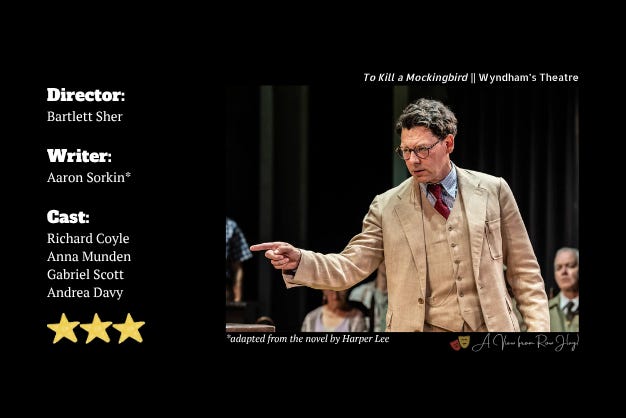
Aaron Sorkin, the screenwriter best known as the creator of every American liberal’s wet dream, The West Wing, loves nothing more than the mythical “good Republican” (see: The Newsroom), so it’s easy to figure out what attracted him to the character of Atticus Finch. As an educated white man in the deeply racist state of Alabama in the midst of the Great Depression, Atticus is symbolic of everything men like Sorkin like to think about themselves and how they would have behaved had they been alive in that era. He stands up against injustice, he fights for the rights of everyone, regardless of race, and he deplores the violence and prejudices of his neighbours and friends. He is, in other words, the quintessential “white saviour”.
Sorkin’s adaptation of Harper Lee’s seminal 1960 novel, which was published at the height of the Civil Rights Movement, is, much like the novel itself, digestible and accessible without shying away from the realities of the Deep South and its dark heart. Lee’s novel has a lightness to it and an almost adventurous tone, seen as it is through the eyes of a woman reflecting on her childhood, and though Sorkin recontextualises the work so that Atticus is much more pointedly the protagonist here, this take on the story is pervaded with that same sense of childlike wonder about, and indeed disappointment with, the world.
The trial of Tom Robinson, a black man accused of raping a white woman, likewise plays a much more prominent role here than in the novel, and Sorkin restructures the narrative so that the trial and Atticus’ defence of Robinson serves as a framing device to the coming-of-age reflections of his two children, Scout and Jem, and their friend Dill. It is here that Sorkin’s adaptation is at its strongest, as the children (played by adults) are forced to come to terms with the fact that the world is cruel, that their father isn’t infalliable, and that the values Atticus holds so dear and has tried to instill in them - values of respect, of politeness, of faith in the system - are wholly inadequate in the face of such violent, racist fervour.
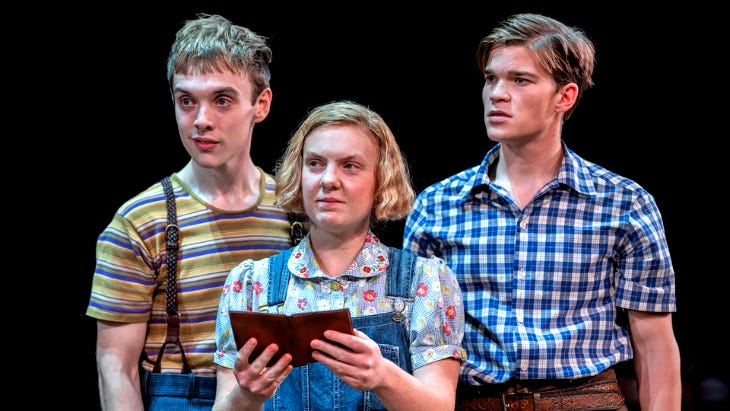
The contradictions between the world the Finches wish to believe in and the one that actually exists around them are interestingly handled, and the manner in which Sorkin weaves the events of the trial, and its subsequent bloody aftermath, into Scout, Jem and Dill’s reflections on the summer they spent together makes for some clever parallels between the world then and the world now, with events like the Charlottesville terror attack looming large over the proceedings. Likewise, though the production is riddled with the sort of quick-witted “Sorkinisms” that sound profound in the moment but dissipate on contact with air, the attempts to make Atticus a little less perfect and to give Calpurnia more of an assertive and active role are worthwhile.
The real strength of this production lies in the four central performances, however. Atticus has been played by a range of excellent actors on stage, from Jeff Daniels to Rafe Spall to Ed Harris, and Richard Coyle is no exception. His take on Atticus is sensitive and thoughtful but also full of quiet fury, and he makes a character that is, despite his flaws, still placed upon a pedestal by Sorkin, appear believable and real. Anna Munden, Gabriel Scott and Dylan Malyn, who play Scout, Jem and Dill respectively, likewise do stellar work portraying their characters as both children experiencing the story for the first time and as adult narrators reflecting on that time through more cynical, world-weary eyes.
This is a fine adaptation, and fine production, of a much-loved novel and one that tries to correct some of the issues with Lee’s original text. One gets the sense that there is an element of Go Set a Watchman, Lee’s first, more dour draft of what ultimately became To Kill a Mockingbird, in the portrayal of Atticus and the cynicism about institutions, though true to form Sorkin struggles to fully accept that the systems he lauds didn’t err in the case of Tom Robinson but were rather designed to reach the verdict they did. It’s “don’t boo, vote!” as a play, and though that leaves a lot to be desired, it’s an effectively done take on that mantra all the same.
Tickets for To Kill a Mockingbird are available here.