

Review: The Playboy of the Western World
[Lyttelton Theatre at the National || December 11th 2025 to February 28th 2026]

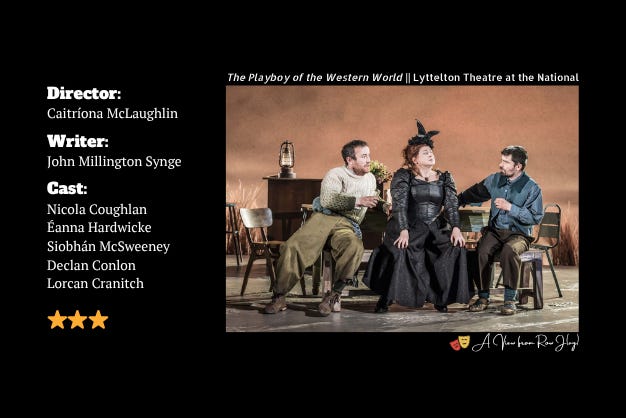
When John Millington Synge’s tale of patricide and the allure of the philanderer and the interloper first premiered in Dublin well over a century ago, it was considered such a grotesque affront to the moral fibre of the Irish nation that it resulted in mass rioting. Caitríona McLaughlin’s production, which graces the Lyttelton Theatre and is the latest in a line of Irish plays staged at the National in recent years, is unlikely to provoke quite as visceral a reaction, though it is curious that a play with such fable-esque qualities and such an obvious moral core was considered the height of decadence and debauchery in 1907. How times change, eh?
Part-farce and part-problem play, Synge’s text tells the story of Christy Mahon, a young man who arrives at a pub in County Mayo in a manic state, claiming to have murdered his own father eleven days prior. Though initially shocked by the revelation, the townspeople quickly warm to Christy’s masculine “courage” and the adriotness with which he regales them with his story and, rather than surrendering him to the police to be surely hanged, allow him stay at the pub, where he becomes besotted with the owner’s daughter, landlady Pegeen. Christy soon becomes a minor local celebrity, with the women of town slipping into an almost Bacchanalian frenzy over him as they compete with each other for his affection, but it soon becomes clear that Christy’s story isn’t all it seems.
Reuniting Nicola Coughlan and Siobhán McSweeney, two stars of the much more recent Irish export Derry Girls, McLaughlin’s take on the text is one that relies heavily on the comic skills of its performers to sell the narrative, and though McSweeney in particular is hardly challenged by the material, both she and Coughlan are the strongest elements of this production. Coughlan’s fiery facade masks her character’s deep sensitivity and insecurity and, for all of her sass and flirtatiousness, McSweeney’s character exudes a loneliness and a sadness that, though not fully developed, adds depth to her personality. When the text examines grand ideas of folklore and mythologising, particularly as they relate to the national story of Ireland and the madness of men, crowds and, most of all, love, both women are able to root it in the intimate and the personal, so that it feels real and contemporary.
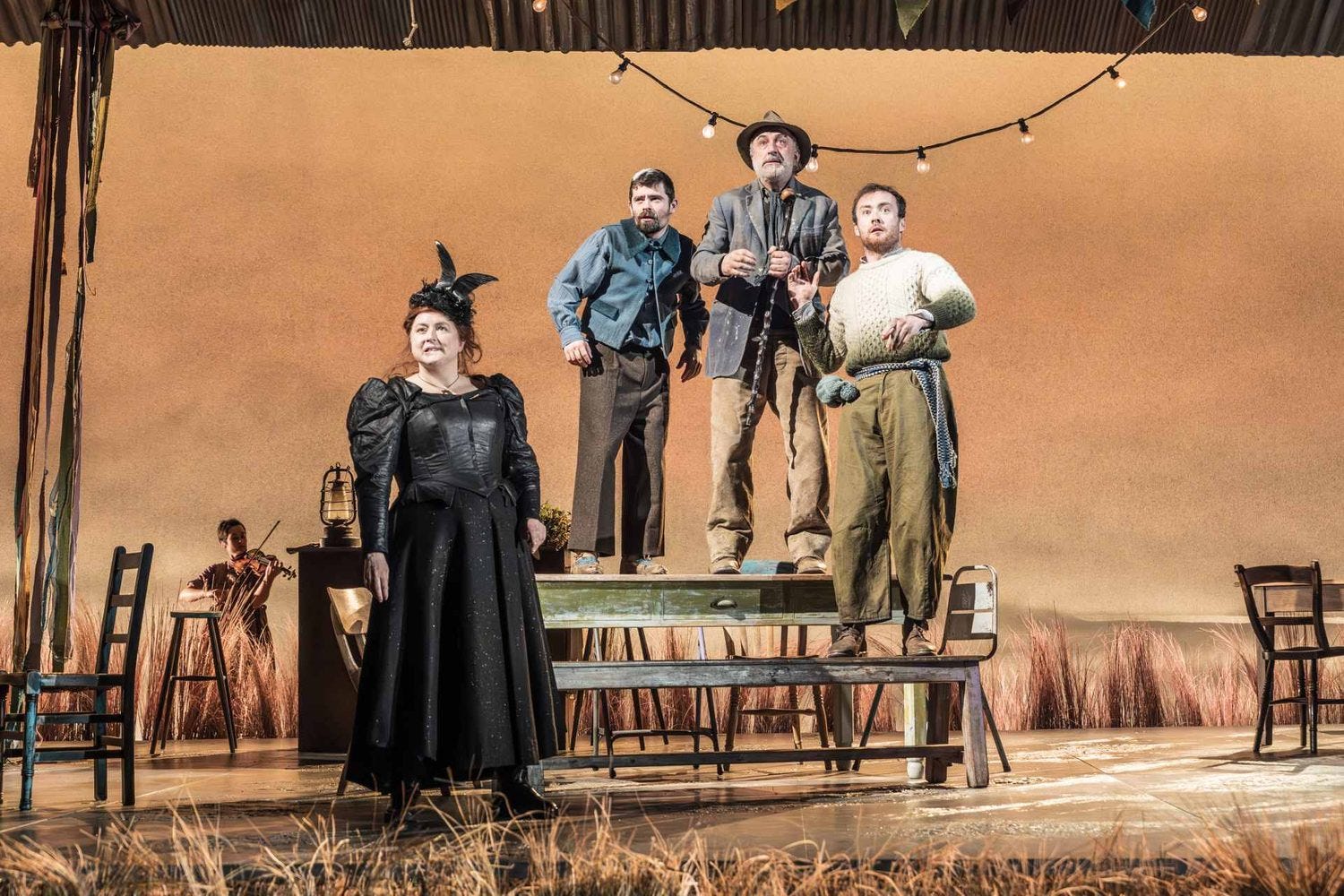
Alongside them both as Christy is Éanna Hardwicke, who was remarkable in The Sixth Commandment back in 2023, winning plaudits and awards for his performance as confidence trickster and murderer Ben Field. Here, unfortunately, his performance is overwrought and erratic, as though he hasn’t been given enough direction. He gurns and whines through the first act, and though he is stronger post-interval, when there is more capacity for him to be unhinged and embrace his character’s delusional nature, it’s all overdone and detracts from some of the other performers, who are forced to meet him at a level that is ill-suited to their characters.
This inconsistency is also apparent in the clash between McLaughlin’s direction, which is heightened and regularly leans strongly into the farcical elements of the play, and Katie Davenport’s set design, which offers a mishmash of rustic furniture - some of which, for some reason, is nailed to the walls - and fields in the background; in other words, exactly how you might expect a play set in early 20th century Ireland to look. This juxtaposition is sometimes quite effective, such as in the immediate post-interval dance sequence or when Christy finds himself in a brawl with a group of people trying to string him up, but it just as often feels as though McLaughlin hasn’t got a firm grip on what she wants to do with the material.
Nonetheless, there’s quite a lot to like here. Synge’s text has a lilting poetry to it and this production is at its most effective when it captures the play’s clever blend of desperate longing and absurdist humour. Coughlan and McSweeney are very good - and so too are Declan Conlon, Marty Breen and Fionnuala Gygax - while the attempts to contrast the mania of the townspeople with the blandness of their environment, though not always successful, are interesting. Alas, Hardwicke’s performance undermines the production quite a lot - ironically when he’s trying to be a little more reserved - and leaves his character with nowhere to go in the final stretch.