

Review: The Car Man
[Sadler's Wells || July 28th to August 29th 2026 || 1h 55m]

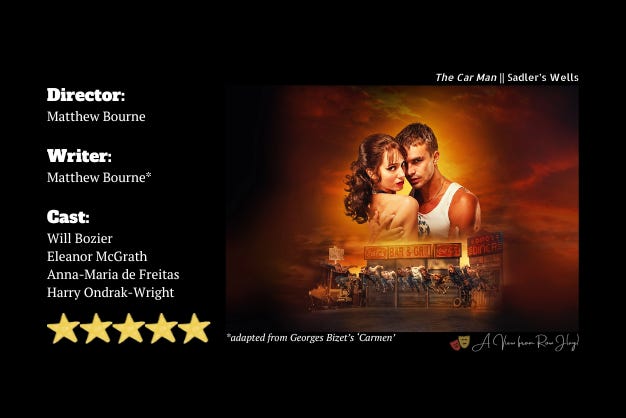
First performed in 2000, Matthew Bourne’s seminal dance production returns to Sadler’s Wells for a rather felicitous run as London is plunged into yet another heatwave. Only very loosely based on the Bizet opera from which it takes its name - as Bourne himself admits, his show and Carmen are far more linked by themes and atmosphere than by narrative1 - The Car Man has much in common with a film noir, and shares far more plot points with The Postman Always Rings Twice than with any opera. Nonetheless, such is its popularity and acclaim that the production has become synonymous with the original tale of Carmen and, such is the strength of the association between his show and Bizet’s, a number of recent productions of the opera, not least Calixto Bieito’s 2012 revival for the ENO, which returned to the Coliseum just last year, have employed visual motifs similar to those used by Bourne.
A tale of lust and deception and betrayal that is tinged with queerness and yearning, The Car Man is set in the fictional backwater town of the ironically named Harmony, USA. Centered around a garage and diner, both of which are owned by Dino, a brutish, swaggering cad of a man who is cruel to his wife Lana and to his employees, the narrative begins with the arrival of Luca, a drifter and the titular “Car Man”, who gets work at the garage and antagonises the other mechanics by flirting with their girlfriends. Within weeks, the rapacious Luca has become locked into affairs with both Lana and Angelo, another of Dino’s employees and the boyfriend of Rita, Lana’s sister. Before long, Dino is dead, Angelo is incarcerated, and Luca and Lana await an inevitable reckoning. EastEnders eat your heart out.
Though the reference to EastEnders is a little facetious, there’s no denying how adjacent to a modern soap opera The Car Man is. It’s a ludicrous melodrama, full of heigtened emotion that is further intensified by Terry Davies’ score, which expands on that of Alberto Alonso and Rodion Shchedrin’s 1967 production Carmen Ballet. It’s histrionic and excessive, with a plot driven by characters who cannot help but make poor decisions that are motivated almost entirely by primal instinct, and the fatalistic nature of the narrative, which recalls a Greek tragedy in its depiction of fallen, flawed men (and women) and the inescapable retribution that stalks them in the final act, leaves the audience in no doubt as to how it will all conclude. It is, in effect, the consummate, albeit wordless, opera. It is also, for all of these reasons and more, a bonafide masterpiece.
What Bourne instinctively understands about his show is that, for all of its high drama and intense emotion, it holds capacious possibilities for lightness, humour and joy, which Bourne exploits with relish. His show is sexy, yet always in a way that recognises that the best sex isn’t just animalistic and passionate but also unserious and funny, while the melodrama, so intrinsic to both opera and dance, is treated with the utmost respect. The hyperbolic emotions and reactions are intentional because this is a story of heightened human caprices. It’s all lust and rage and vengeance and sorrow. These aren’t emotions that can be safely constrained beneath veneers of politeness; they’re impulsive and deserve, nay need, to be expressed forcefully.
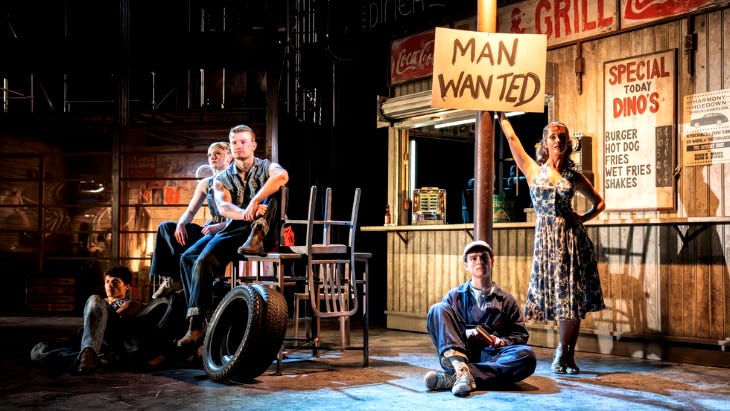
With little opportunity to vocalise these emotions, other than via the occasional grunt or yell, the characters must instead do so through movement. Here, there is a stunning musicality to the piece as the characters become almost trapped in carnal embraces and stand-offs that, much like the cars and the overalls and the prison cells that comprise so much of the set, are deeply eroticised, with Bourne choreographing them with a glorious precision but one that hints at their desire to break loose from the very movements into which he has locked them, as though they are straining for liberty from the heat and the fatigue of life in Harmony. Their movements are at once specific and fluid as their bodies merge and meld into each other, initially surrendering to desire, then trying to resist it, and ultimately succumbing to it even more violently, as though lost in some spectacular, endless orgasm.
The dancers, so expressive and controlled in their movements, are likewise remarkable, and Bourne’s vision explodes vigorously into life in their hands (and, of course, feet). There is such a wealth of majestic sequences dotted through the show, from Luca’s flirtatious Habanera on his arrival to the start of his affair with Lana, which begins with him sultrily polishing a car while she kneads dough and ends with the stage awash with dancers and flooded in a crimson light as everyone succumbs to their base desires. In this particular dance, bodies collapse into one another, as though all part of some sexual hive mind, yet each individual is explicitly and purposefully choreographed to create an image of a town wracked with lust and heat, desirous not just of each other but also of escape and independence.
This desire for freedom is perhaps best expressed in act two, in what is the show’s most impressive sequence. Angelo, locked in prison, dances beneath the shadows of cages as the cells clank and rattle around him - shout out to Chris Davey and Paul Groothius, the light and sound designers respectively, for their gorgeous work here and throughout the show - with a palpable aching for justice and liberty. Harry Ondrak-Wright, as Angelo, captures all of the character’s tragic desperation with a tenderness that boils and froths into an all-consuming fury, culminating in the most spellbinding display of vivacity as Angelo is afforded an opportunity to escape and take his revenge on those who have wronged him. Though it isn’t the conclusion to the show, the sequence feels like the climax to all of the ideas that Bourne has been developing to that point, and it is without doubt one of the most extraordinary displays of movement and music that I have ever seen.
Believe the hype. This is a real tour de force from Matthew Bourne. It’s lascivious and thrilling. Everybody involved in it, not least the four leads at this particular performance of Will Bozier, Eleanor McGrath, Anna-Maria de Freitas and the aforementioned Harry Ondrak-Wright, is captivating, and the show has a rapturous potency that compels you to resist it but knows that you cannot. It’s sexy - and properly so, and unafraid to be (Will Gluck, take note) - and funny and devastating, exuding a heat and a passion that electrifies just as much as it forebodes. The orchestra, likewise, is stunning, and in the combination of music and dance, Bourne has crafted something truly breathtaking. I cannot recommend it enough, and I suspect I might see it again, with some of the other leads, before the run is through.
Fab-u-lous!
Tickets for The Car Man are available here.