

Review: Teeth 'n' Smiles
[Duke of York's Theatre || March 13th to June 6th 2026]

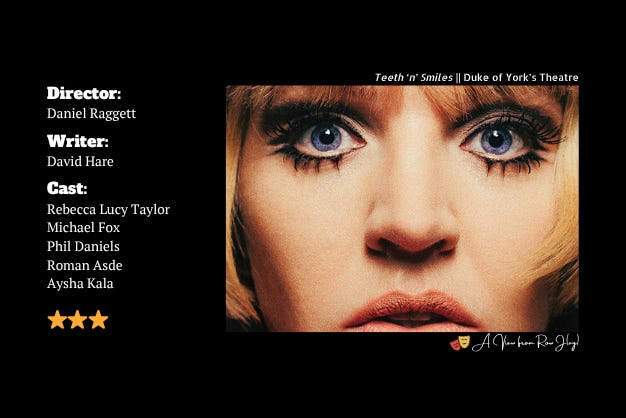
Rebecca Lucy Taylor, better known as musician and songwriter Self Esteem, is something of a revelation in Daniel Raggett’s revival of David Hare’s Teeth ‘n’ Smiles. As Maggie Frisby, the nihilistic, alcoholic frontwoman of a rock band that is in the process of spectacularly imploding over a single night in the dying embers of the late-sixties, she is pugnacious and pitiable, and she tears through the play’s numerous songs with all of the ferocity and raw talent one might expect. It is in the quieter moments, however, when the music fades and all that’s left are the recriminations and regrets of the various characters on stage, that she properly shines.
Set during a gig at end-of-year May Ball at Jesus College, Cambridge, Teeth ‘n’ Smiles follows the band as they try to navigate Maggie's increasingly chaotic and harmful behaviour, while also conspiring, albeit reluctantly, with their manager, Sarrafian (a superlative Phil Daniels, who is clearly having the time of his life on stage) to have her sacked. As events spiral out of control and the relationships within the band become ever more fractured, the play explores how the great promise of the post-war consensus and the cultural revolution of the 1960s began to buckle and how disillusion leads so easily to ennui and, eventually, surrender.
There’s a rueful nostalgia and gruelling dissatisfaction with the present pulsing through Teeth ‘n’ Smiles that pierces and stings. Though written in ‘75 and set in ‘69, the notion of the promised land collapsing beneath the feet of the zealots who no longer believe feels as pertinent now as it ever has. Remember when we were teenagers? We were going to change the world and fix the mistakes of the previous generation, right? A better future was ours for the taking. We just had to make it matter, make it count. The music we listened to, the artists we admired, they were going to start a fucking revolution - the inevitable, long-awaited revolution, after all those years - and things would be so much different. Except… they weren’t, or at least not in the way we hoped. And nor will they be. Indeed, as the play so solemnly concludes, “the ship is sinking but the music remains the same.” Or, as the great philosopher of our time, Edina Monsoon, once said:
“All that hope, all that future, darling! But do you know something? Once the party's over, you look around, you're still standing in the shit!”
Though the more intimate and personal drama between Maggie, the band and Saraffian does pack some emotional weight, it’s in this cruel but depressingly honest idea of a better future ripped from the hands of yet another generation that Teeth ‘n’ Smiles is at its most affecting. The lyrics of the songs, including a song specially written by Taylor for this production, don’t just capture a band in freefall but a world crumbling and spiralling far beyond our understanding, and the way Taylor and the ensemble perform them - passionate, erratic and desperate - heightens the sense of hopelessness that the characters feel beneath all of their facades and their egos.

It's also a text rooted in class. Hare takes aim at both the Cambridge elites who have hired the band and the band members themselves, who have long surrendered any pretence at authenticity, instead acquiescing entirely to a comfortable, easy hedonism. In this respect, it's somewhat less successful. Whether a flaw in Hare’s script or merely in this particular production, outside of Maggie and Sarrafian, the band morphs into a homogenous blob with the individual members never really anchored in anything real. They tend to merge and collapse into one another and though this might be by design, the effect is to alienate them from the audience in a manner counterintuitive to the play’s universal ideas of shared national decline.
Furthermore, whenever Taylor and/or Daniels aren’t at the centre of the drama, the play’s archaicisms become quite distracting and its momentum stalls. Hare’s script is, for all of its melancholic insight, a little too chauvinistic and cynical, even by the standards of the seventies, and the comedy is somewhat hit and miss, despite the best efforts of the rest of the ensemble to embrace the text’s more anarchic, slapstick streak. Nonetheless, it remains an entertaining and emotional production that, thanks to Daniel Raggett’s stylish direction and Chloe Lamford’s superb set design, both of which effectively portray the punky mileiu of the late sixties, when the revolution was collapsing, the future was fucked and the acid dream was well and truly over.
This is a good production with flickers of greatness, and Rebecca Lucy Taylor is magnetic as Maggie. It's a little dated in its portrayal of “troubled” women but Hare still awards Maggie the agency to make and own her mistakes, and her despondent view of the world and her role in it is worryingly relatable. When she stumbles around the stage, damning everybody and clutching a bottle of Johnnie Walker like a child clings to its favourite teddy, it's hard to escape the thought that maybe she's right - maybe none of it matters - and this is largely a result of how convincingly Taylor plays her.