

Review: Springwood
[Hampstead Theatre || June 19th to July 25th || 2h 10m]

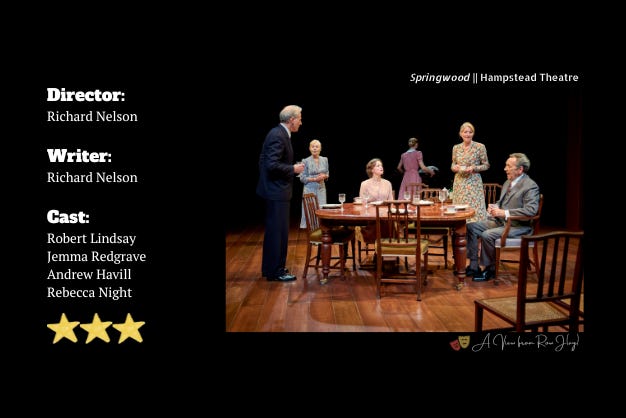
What is the meaning of a hot dog? That is the symbolic question posed by Richard Nelson’s Springwood, a loose adaptation of Roger Mitchell’s 2012 film Hyde Park on Hudson, also written by Nelson, which presents a fictitious account of the visit by King George VI and his wife, Queen Elizabeth (the Queen Mother), to the home of President Franklin Delano Roosevelt in 1939. With inevitable war with Germany looming, the King, relatively recently crowned following the abdication of his Nazi-sympathising brother, visited America - the visit British monarch to do so - to seek assurances from Roosevelt that, if and when war arrived, the Americans would defend Britain and help to liberate Europe from the tyranny of Hitler. Thus began the quote-unquote “Special Relationship” to which the two countries have been lashed ever since.
Taking its name from the New York estate in which Roosevelt was born, raised and ultimately buried, Springwood is pointedly timely in its depiction of a British monarch visiting America in order to advocate on behalf of British interests and in favour of defence against tyranny. Though the circumstances are somewhat different now - the call of the tyrant is very much coming from inside the (White) House, so to speak - Nelson draws clear parallels between George VI’s aims and those of the current occupier of the throne, focusing on the reluctance of the so-called “land of the free” to actually defend freedom and, in Roosevelt’s case at least, the disconnect between a president who wants to help and a population exhausted by economic turmoil and war, a significant number of whom aren’t entirely unsympathetic to the cause of the aggressors.
While it’s very much a dusty old antique shop of a play - though I do mean that lovingly - Springwood is pleasantly dry and witty, with a real sense of humour about itself. For all of the seriousness of the subject matter, Nelson’s script is light and playful and, particularly in the second act, quite layered in its exploration not just of the “Special Relationship” but also of the unconventional relationship between FDR and his wife Eleanor and of the fractious and sometimes stiff relationship between George and Elizabeth, both of whom were thrown into their roles somewhat unexpectedly. Hints are made at the queerness of Eleanor and Nelson explores the lengths to which people went to hide FDR’s polio and indiscretions from public view, which feels quite quaint in an era where we expect to know everything about our politicians.
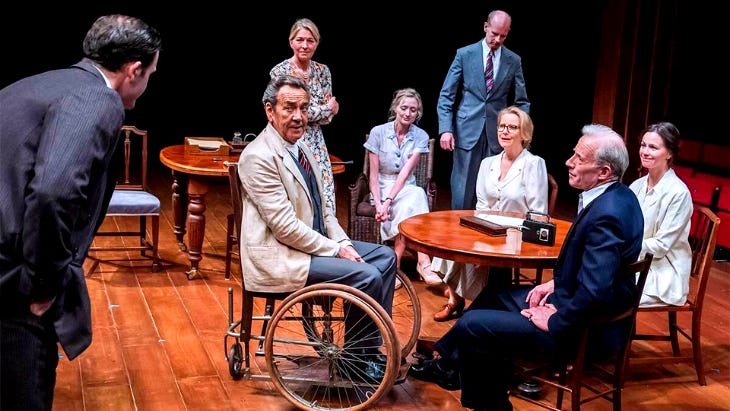
The initial intention was for Stanley Tucci (yes, that Stanley Tucci) to direct this but he was unable to due to “scheduling conflicts”. As such, Nelson also directs and it is here that he is found wanting. It’s impossible to know how Tucci would have approached the material but Nelson plays things very safe. The scene transitions are simple, the set design is uninventive and the lighting has but two modes: on and off. This sometimes leaves the play struggling for momentum and energy as, though the script is funny and the performances are decent, there are regular pauses to indicate a scene change and these are, though smooth, quite lazy and bland and often stall the play in its tracks.
The performances are excellent, however, and Robert Lindsay as Roosevelt and Andrew Havill (who has starred in Hyde Park on Hudson and The King's Speech, albeit in different roles) as King George VI are particularly good and make the camaraderie and friendship between the two men both believable and engaging. Jemma Redgrave, whose television performances I regularly find stilted and lacking in confidence, is similarly decent here as Eleanor Roosevelt, occasional lapses in accent aside, while Rebecca Night plays the queen as suitably paranoid and irritating. The ensemble make this work, even in its stuffier moments, and their natural comic timing and easy presence elevate both the humour and the drama of the piece.
So, what is the meaning of a hot dog? For Nelson, the food, served at a picnic held in honour of the visiting monarch, represented how despite their differences in values and upbringing, FDR and King George VI were able to find common ground and present as one when it really mattered. This is perhaps both the play’s greatest strength and its most obvious weakness: Nelson’s writing is well structured and he flirts with many themes, yet he is much too enamoured with the idea of the “Special Relationship” to analyse it critically. As such, the play is never quite gritty or forceful enough - though it is Hampstead Theatre, so I guess you can’t expect that - despite it being consistently entertaining and amusing.
Tickets for Springwood are available here (though the show closes on Saturday).