

Review: Romeo & Juliet
[Harold Pinter Theatre || March 19th to June 20th 2026]

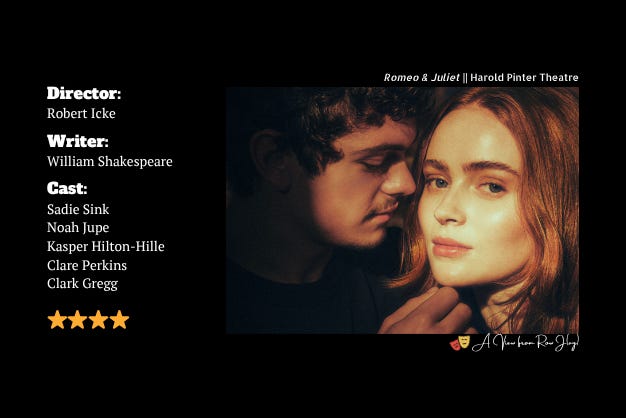
It hasn’t even been two years since Jamie Lloyd’s calamitous adaptation of literature’s most famous love story concluded its run at the Duke of York’s Theatre and yet, just five minutes away from the scene of that monstrous crime, a new take on the material has already rolled into town. However, given the quite urgent need to scrub Lloyd’s production from the nation’s collective consciousness, I’m inclined to think the eponymous lovers deserve this shot at redemption, not least because theirs is an unfairly maligned story (in no small part thanks to its presence on the GCSE English Literature curriculum) and one that deserves to be retold by somebody who actually understands it.
Enter director Robert Icke, who boasts an enviable track record with regards to successful twists on classic texts. In recent years he has reimagined Arthur Schnitzler’s tale of medical ethics and mob mentality, Professor Bernhardi (rechristened as The Doctor), for the era of social media show trials, toyed with perspective and interpretation in a production of Mary Stuart that left the casting of the two lead roles to chance each night, and offered a modern spin on Oedipus in which the titular tragic hero is a populist politican on the cusp of a great election victory. In all of these cases and more, Icke has adapted, contemporised and played with place, time and even narrative, but he has always done so with a real cognisance for the emotional and thematic core of the stories he’s telling, thus ensuring their hearts never stopped beating.
The same is true of his spin on Romeo & Juliet, and impressively with barely a syllable changed or excised from the text. With a rigour that awards him the chance to be playful when he wants to be and sombre when he needs to be, he blends the lyrical pace of Shakespeare’s poetry, which propels the protagonists towards disaster over the course of just a few days, with a sharp, focused directorial vision that is singularly his own. Scenes in which he takes a more interpretive approach to the text - a nightmare sequence in which Juliet foresees the bloodshed that will befall them all, for example, or moments in which snippets of scenes are repeated or interleaved with one another to create a sense of cascading inexorability - do not detract from Shakespeare’s words but instead enrich them as Icke laments the star-crossed lovers cruel destiny.
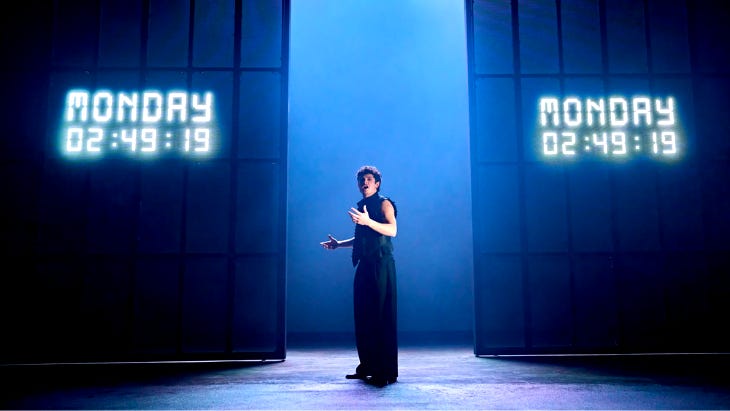
A production rich with stark visual motifs of the implacable nature of finiteness and finality, Icke’s Romeo & Juliet feels like a distillation of all of the fate and inevitability that is so central to the tragic impetus and impulse of the text. The set, so cleverly designed by Icke’s regular collaborator Hildegard Bechtler, ominously looms over the protagonists. A digital clock emblazons the walls behind them, emphasising the haste of their romance while simultaneously counting down to their deaths, while there is a fluidity to the set, with its constantly shifting parts, that quickens the momentum and drags us ever closer to their final kiss. All the while, Icke ponders the text’s ‘sliding doors moments’, desperately willing the characters to make different choices but ultimately unable to prevent or even delay the play’s violent ends.
It is in these almost insignificant moments - in the what-ifs and the what-could’ve-beens - that the tragedy becomes all the harsher and more galling. What if Capulet had given the nurse, rather than Peter, the guest list for his feast? What if Juliet had been wooed by Paris at said feast as planned? What if Romeo had received Friar Lawrence’s letter in time? What if all of this could have been avoided somehow? Minor changes to events that are as much the consequences of simple misfortune as of fate are briefly considered before a blinding flash of light “corrects” the narrative and sets the characters back on the path of their misadventured, piteous overthrows, compelling them back into each other’s arms and each other’s death beds. It’s a clever notion that Icke never overuses or luxuriates in, and one that plays with the structure of the text without ever sacrificing its emotional essence.
Yet Icke also understands the bones of Romeo & Juliet, which is, at least until the moment of peripeteia when Mercutio and Tybalt are slain and the tone shifts drastically, a bawdy comedy about two lovestruck, awkward teenagers who make foolish choices and are unable to see further than each other’s bodies. This is a play of horny innuendo and ribaldry; it’s all incessant penis jokes and gags about sex; it’s two libidinous adolescents who disregard a multigenerational family rivalry to fuck each other, consequences be damned. Sure, it’s a tragedy but without all of the humour and the frivolity, the foreshadowed deaths land with a thud, and Icke recognises that, far from being overly dour and solemn, the first three acts are hilarious and goofy and full of lust and yearning.
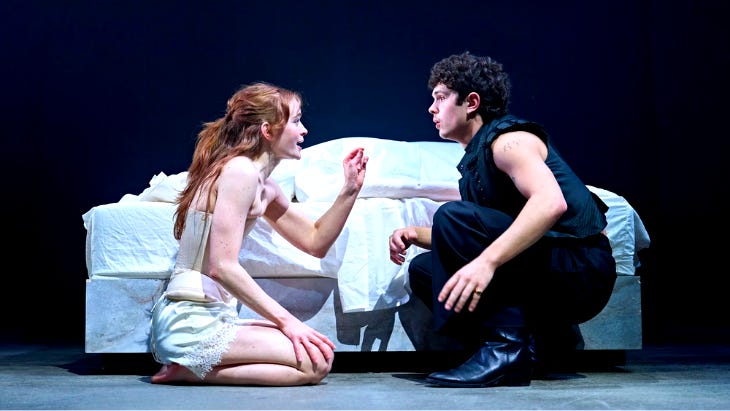
Under his direction, the performances are also superb. Noah Jupe does the impossible and makes a character as naive and narcissistic as Romeo not just likeable but charismatic, albeit in a delightfully ungainly way. Romeo lacks finesse, clumsily brigading Juliet with earnest poetry and kissing her “by the book”, and Jupe plays him as what he is: an overexcitable and rash young man driven by instinct and rarely in control of emotions that he never once takes a moment to process or understand. Sink, likewise, plays Juliet as frenzied, perhaps even neurotic, but not without cause. She’s a character trying to take ownership of a narrative that is almost entirely happening around her. When the two of them are together on stage, their chemistry is electrifying, not because they are mature, confident lovers but rather because they exude all the giddiness and ineptitude of first-time sweethearts overcome by hormones.
Though there are some missteps in the wider ensemble - Aruna Jalloh’s Tybalt has little presence and Eden Epstein’s Lady Capulet feels undernourished - the production also boasts a barnstorming turn by Kasper Hilton-Hille as Mercutio, who is portrayed as an insufferable but unerringly loyal architect of his own senseless demise. Hilton-Hille dominates but does not overwhelm his scenes; he is lewd and lively, which juxtaposes nicely with the sensitive demeanour of Jupe’s Romeo and makes Romeo’s sudden descent into a violent rage against Tybalt all the more shocking. The ever-reliable Clare Perkins, similarly, has exquisite comic timing as Juliet’s nurse and brings a low-level cynicism borne of experience to the role that exacerbates just how integral she is to the events that unfold before us.
This isn’t a perfect production: acts four and five are unevenly paced (Shakespeare’s fault mostly, though Icke struggles to navigate the issue) and some of Icke’s choices, while always interesting, feel a tad underdeveloped. Nonetheless, it’s still a very good production that captures not just the miserable lows but also the impossible highs of the titular lovers’ story. Noah Jupe and Sadie Sink are both excellent - far better, I must admit, than I expected them to be - and Icke’s direction is confident and compelling, taking a text we all know and offering a fresh perspective on it without seeking to undermine it.
See what’s possible when a director does something radical like reading a play before directing it?
Tickets for Romeo & Juliet are available here.