

Review: Redcliffe
[Southwark Playhouse Borough || May 22nd to July 4th 2026 || 2h 30m]

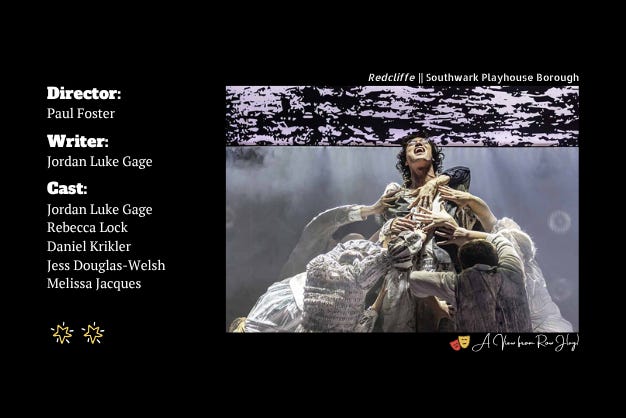
In 1753, William Critchard, a footman, and Richard Arnold, a seaman, were hanged in the district of Redcliffe, Bristol, for "the detestable crime of sodomy”1, an act which carried a death sentence in England until as late as 1861. According to contemporary records, the two refused to repent on the gallows and, in an act of defiance against their persecution, Arnold is reported to have kissed Critchard's hand before both men were, in the euphemistic parlance of the time, "launched into eternity". Though theirs is just one of many tales of men who fell victim to the violent religiosity and oppression of the time, Critchard and Arnold's courage in their final moments is tinged with a gorgeous theatricality, and so it's easy to see what drew debut writer Jordan Luke Gage to their story.
Queer theatre harks to the past like few other genres, doing so not as a comfort but as a caution. Liberation was and still is a battlefield strewn with the broken bodies of those who came before us, and as the UK backslides ever more rapidly on LGBTQ+ rights, we would do well to remember this. Running through queer theatre there is however also a perverse and irresistible nostalgia for the surreptitious otherness that has since been sacrificed on the altars of acceptance and assimilation. The story of Critchard and Arnold - two men whose romance was swift and ultimately deadly - reminds us that yes, we’ve always been here, but also that our love used to be braver, and perhaps needs to become so again.
Alas, to tell a tale of courageous love well requires a courageous writer but, though he is very much an amiable stage presence whose intentions are surely worthy, Gage, who also stars as Critchard, plays it far too safe. The book is often sentimental and pandering, with some limp humour and clunky didaciticism woven through it, while the lyrics are overly earnest and riddled with clichés. Some of the songs - primarily, the solo numbers - are effective, and the vocals are decent if unremarkable, but it all feels like it’s still being workshopped, with no real sense of what the tone or the aesthetic is quite meant to be.
Likewise, Gage struggles with debut writer syndrome and, in trying to say so much, he ultimately ends up saying very little. Pare Redcliffe right back and strip out most of the superfluous characters - heck, take a big swing and turn it into a two-man show - and you have the makings of a half-decent one-act musical about queer love in the face of intolerance and injustice. The show (mostly) succeeds when Gage cuts out the noise and the distractions and focuses on the love between Critchard and Arnold, everyone else be damned, and so much of what doesn’t work here happens on the periphery of their story, which is why the show frustrates as much as it does.
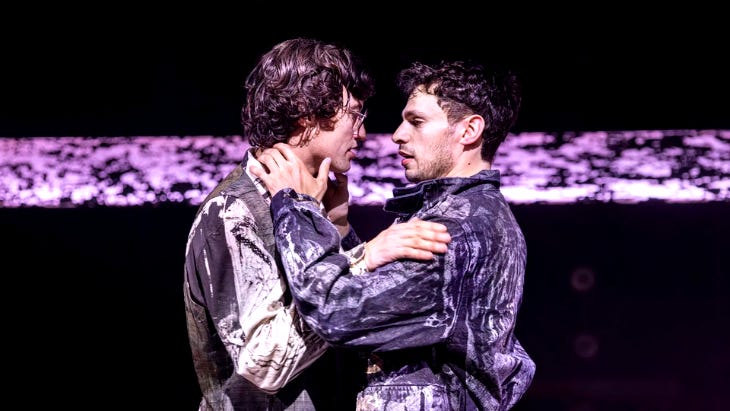
But Gage does have promise as a writer. He can generate meaningful emotion and there’s a sweet naturalism to the interactions between the two lovers but he lacks the formal control to keep the piece from straining and buckling around him. The musicality, similarly, is ill-defined, with a number of forms and genres hurled into the pot in the hope that something palatable can be formed from the ingredients. And yet, there are a couple of songs that really do capture something interesting, even if an ironic but disastrously misjudged jaunty number about a hangman threatens to permanently derail the whole enterprise in the second act.
Gage himself is perfectly fine as Critchard and he has a pleasant enough voice, albeit one that is occasionally drowned out beneath the wave of breathy harmonies that the play resorts to whenever it strives for sincerity. His chemistry with Daniel Krikler, who was excellent in Natasha, Pierre and the Great Comet of 1812 at the Donmar Warehouse last year, is warm and affecting, though Krikler does a lot of the heavy lifting in the scenes when they're alone, and his vocals are tighter. Nonetheless, the two of them do have a likeable spark and it is a shame that Redcliffe dedicates a relatively small amount of time to the two of them.
Rebecca Lock, who plays Critchard's mother, is perhaps the best advertisement for what this show could have been and, with some further work, could yet be. More than anyone else on the stage, she understands how to navigate the shift from broad comedy to tragic melodrama, and her solo ballad in act two is a real triumph. She has the pipes, the comic timing and the ability to get to the emotional heart of the story in a way that everyone else struggles with.
At the end, we are reminded that, though this is a tragic tale from a bygone era, same sex love is still punishable by death in twelve countries across the globe, and it's that sense of injustice and urgency that the rest of the production lacks. Nonetheless, I found myself surrounded by people weeping loudly and had a Principal Skinner moment as I wondered whether I was so out of touch (no: it's the public who are wrong). I do think Gage has good intentions and there are flickers of promise here but this just doesn't work holistically, and that's largely down to a lack of rigour and control in the writing.
Critchard's slutty little glasses are great though.
Tickets for Redcliffe are available here.