

Review: Mother Courage and Her Children
[Shakespeare's Globe || May 22nd to June 27th 2026 || 2h 30m]

What better way to experiece pure, undiluted Brechtian alienation than by slowly roasting to death in the middle of an outdoor theatre at the height of yet another heatwave? With the evil sun blazing down on the audience, Elle White’s production of Mother Courage and Her Children, Brecht’s anti-war, anti-fascist diatribe, felt all the more like an exercise in collective penance, something that the playwright would’ve surely welcomed, especially given that his play, written in the immediate aftermath of Nazi Germany’s invasion of Poland, tells a story of a continent burning beneath the weight of political decisions made by people who will never have to suffer the consequences. How damningly fitting.
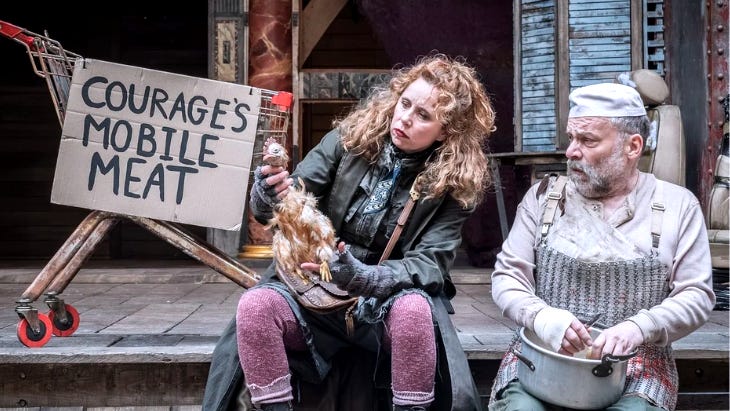
Set over the course of twelve years, Mother Courage and Her Children follows the titular characters as they traverse a ravaged, divided and wartorn Europe, selling goods from a cart to soldiers. As the war wages and the years pass, Courage loses her children to conscription and violence and her alliances - if one can call them that - shift in the pursuit of money. With a pointedly Trumpian attitude to business, Courage seeks profit wherever she can. At various times she flogs “Courage Ammo”, “Courage Burgers” and even sex work, her moniker associated not with heroism or bravery but rather with cold, hard, calculating capitalism. She is neither courageous nor motherly, yet she is the avatar through which the audience must experience the play’s increasing cruelty.
As the play progresses, its paradoxes begin to reveal themselves. It is, despite Brecht’s own feelings to the contrary1, a tragic tale, yet in keeping with his principles for drama there are no fallen heroes of fatal flaws here. Courage isn’t a good person felled by some personal failing but rather she, like everyone else in the play, is a pawn of something much greater and unconquerable. Everyone is existing and surviving beneath the vast, ravenous spectre of war and violence, which erodes their humanity and transforms them into amoral husks. Every decision has a consequence, not least Courage’s obsession with profiteering, which causes her to lose all three of her children, with the audience forced to watch as the most unconscionable terrors suddenly unfold before us.
Courage, too, is a paradox. She deplores war and is desperate for her children not to fight, yet she revels in all it offers her. When peace appears possible Courage panics, fearing that her trade will collapse and she and her children will be forced to live in penury. When one side is no longer able to pay for her services, she follows the other. Her business model thrives on a conflict she detests yet one that she helps to facilitate by providing weapons and ammunition to those who are fighting. It is in this paradox that Brecht’s intellectual rage against war and what it does to people is at its most potent, and in all of the hypocrisies of Courage’s character that it is at its most fascinating.
Yet though it is more of an intellectual exercise than an emotional one, when the violence and the horror hits it does so with a forcefulness and bluntness that is gruelling. Anna Jordan’s adaptation of the script leans perhaps a little too heavily into sympathising with Mother Courage but the stark, sudden tonal shifts from light-hearted ribaldry to the most callous, unfeeling savagery are both impactful and, though foreshadowed and inevitable, shocking. It is an adaptation full of rage and fury that is punchy, funny and scathing in its depiction of how war corrupts and dehumanises us all, and there’s something quite extraordinary in how director Elle White transforms the space into one of persistent terror and trauma.
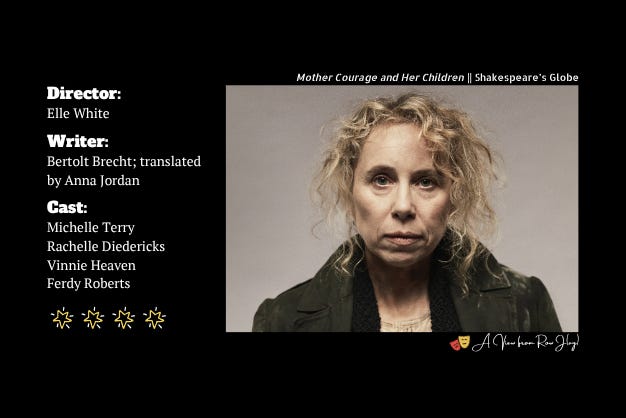
At the heart of it is a barnstorming turn by Michelle Terry, who is also the Globe’s artistic director, as Mother Courage. She tears through Jordan’s adaptation of Brecht’s dialogue with a captivating ferocity, playing her like some cockney wide woman trying to sell her wares to anyone and everyone down the covered market. She traverses the various intersections between bawdy humour, devastating sadness and violent rage with an acute sense of who her character is and what motivates her, so that in the play’s final moments we cannot help (apologies Bertolt) pitying her, in spite of her coldness.
The rest of the ensemble is excellent too. Ferdy Roberts, who plays an alcoholic minister who lashes himself to Courage’s travelling market, is robust and thoughtful in a role that is sometimes in danger of becoming too comedic, while Rachelle Diedricks is excellent as Courage’s voiceless daughter Kattrin. Courage’s two sons, played by Vinnie Heaven and Rawaed Asde, bring comedy and tragedy to the piece, and there’s a sweetness and softness to them both that makes the violence they encounter and endure all the more gutwrenching.
At a time of increasing global instability and uncertainty, inflicted on us by a political class obsessed with profit and legacy, the lessons of Mother Courage and Her Children are as pertinent as ever, and this production, with its allusions to the wars in Ukraine, Gaza, Sudan and beyond, is unforgiving in its rage against the machine. This is only on for a few more days - and those are threatening to be even hotter still - but I highly recommend it for anybody who feels that they aren’t suffering enough in this wretched, damnable heat.
Tickets for Mother Courage and Her Children are available here (though it concludes this weekend)