

Review: Indian Ink
[Hampstead Theatre || December 3rd 2025 to February 7th 2026*]


Travesties; Arcadia; Leopoldstadt; The Real Thing; Rosencrantz and Guildenstern are Dead: if you had just one of these plays in your back catalogue, you could be pretty certain of near-elegiac obituaries when your time came. Stoppard had them all and then some, and so it is no surprise that his death in late November resulted in outpourings of praise and reminiscences from fans and an industry devastated by the loss of one of the greatest playwrights of the past century. His mastery not only of language, which was as exquisite and poetic as it was playful, but also of science, mathematics, philosophy, theology, history and the arts enabled him to explore that most base, cruel, wonderful, violent, essential, tragic and life-affirming human condition of all - love - with a wit and an insight that most of us could only dream of possessing.
In the past few years, the jewel in the… uhh… hat of Hampstead Theatre’s programming has been their annual productions of some of Stoppard’s lesser-staged plays. With direct involvement from the man himself, in 2023/24 they staged a solid production of Rock ‘n’ Roll, which was followed in 2024/25 by an excellent revival of The Invention of Love, starring Simon Russell Beale. Now it’s the turn of Indian Ink, a 1995 adaptation of Stoppard’s own 1991 radio play, In the Native State, which sees Felicity Kendal return to the play - albeit in a different role - three decades after first starring in it. Alongside Kendal are Ruby Ashbourne Serkis, daughter of Lorraine Ashbourne and Andy Serkis, and Gavi Singh Chera, the play’s two leads.
A dual narrative set across two distinct eras, Indian Ink sees Stoppard return to one of his major philosophical preoccupations, namely the porous border between objective truth and perception, and, in turn, the role that art and literature can play in helping us to navigate a path between and within the two. In the 1930s, British poet Flora Crewe, a “Bright Young Thing”, journeys to Jummapur, India under medical advice to recuperate. There, she befriends a local artist and enjoys all of the luxuries of life as an upper-class British woman in the Raj. Her experiences are narrated in the form of letters written to her sister, Eleanor, who we see in the 1980s. In this timeline, Eleanor meets first with Eldon Pike, an American academic gathering information for a collection of the now-famous poet’s letters and who later travels to India himself, and later with Anish Das, the son of the artist whom Flora befriended and, perhaps, loved.
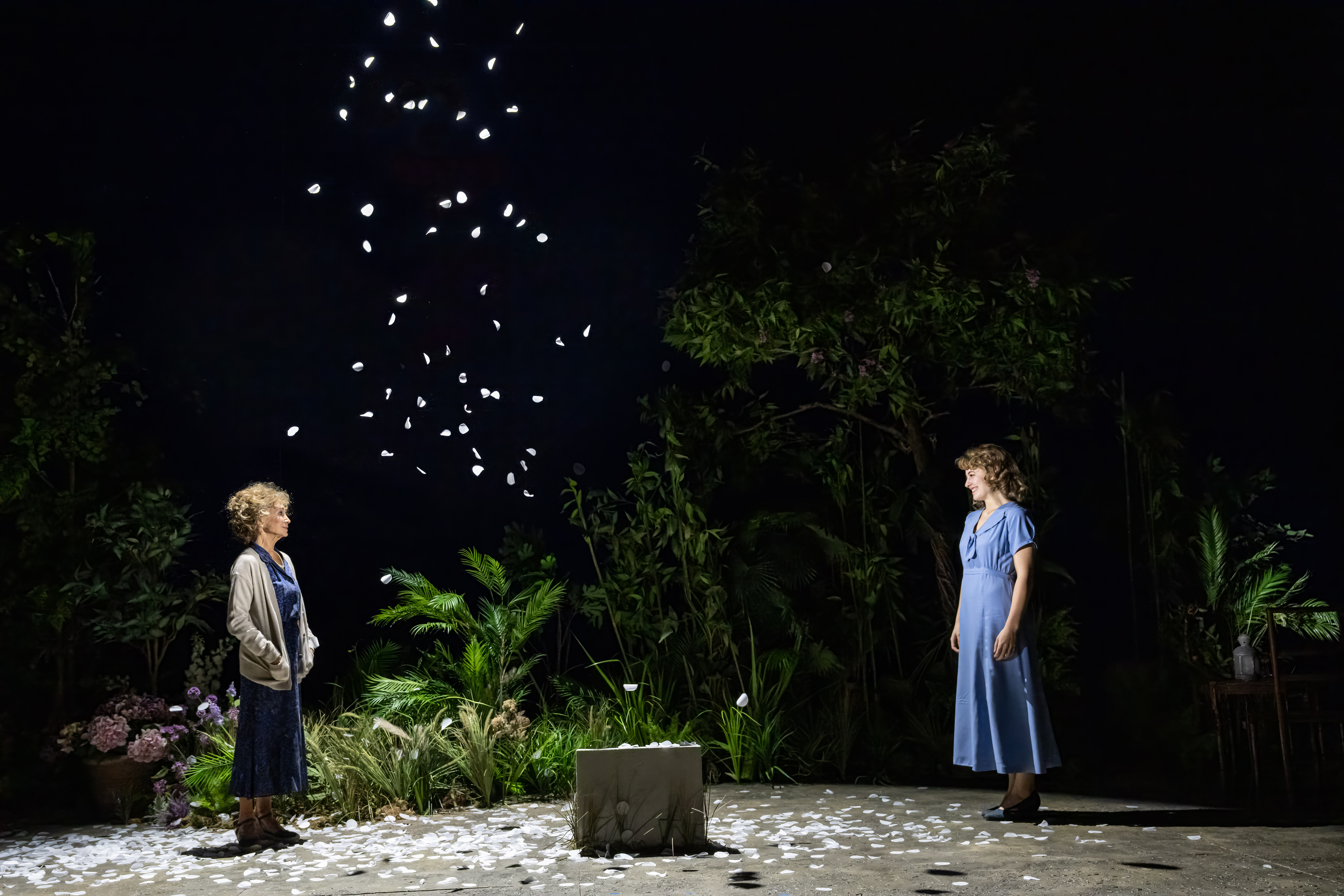
Throughout the play, Stoppard ponders various dichotomies, not just between the past and the present and the real and the hypothesised, but also between wealth and serfdom, modernity and tradition, and oppression and liberation. Director Jonathan Kent stages the production as though there is a literal partition down the stage, albeit one that characters sometimes cross, exacerbating how all of these things exist separately and simultaneously, with their boundaries in flux. For Stoppard, the distinction between truth and perception is almost moot. What matters isn’t what happened, whether to the character of Flora or, more broadly, to India under British rule, but rather what it means to each individual person. As someone says to Pike towards the end of the play:
"You are constructing an edifice of speculation on a smudge of paint on paper, which no longer exists”
For me, this is the crux of Indian Ink. It is a play about how art and poetry and history are at once transient and irradicable, and how the “truths” they reveal exist entirely within the heart of the person experiencing them in any given moment. There is no permanence, except that which we ourselves apply to something. The strength of the text is in Stoppard’s ability to weave this idea into a narrative that is itself open to interpretation and that relies on the unreliability of the narration and of the characters attempting to unpick said narration.
In many ways, however, this is “lesser” Stoppard, and this production does have its faults. The performances are decent and Kendal is a delight, though no-one truly dazzles, and while the staging complements the material and the themes well, it is much too safe and perfunctory, never experimenting enough with how the timelines and perspectives might intersect. At almost three hours, this revival occasionally sags, and though Stoppard explores the myriad aforementioned ideas with all of his usual humour and verbosity, the dialogue doesn’t boast the emotional potency or intellectual rigour of his greatest work.
Nonetheless, this is still a stimulating and enjoyable piece, and I hope Hampstead Theatre continues to celebrate and stage Stoppard’s work (do Jumpers next, please and thank you) for years to come.
*This production is also transferring to the Theatre Royal Bath for a very limited run between February 10th and February 14th 2026.