

Review: Cyrano de Bergerac
[Noël Coward Theatre || June 13th to September 5th 2026 || 2h 45m]

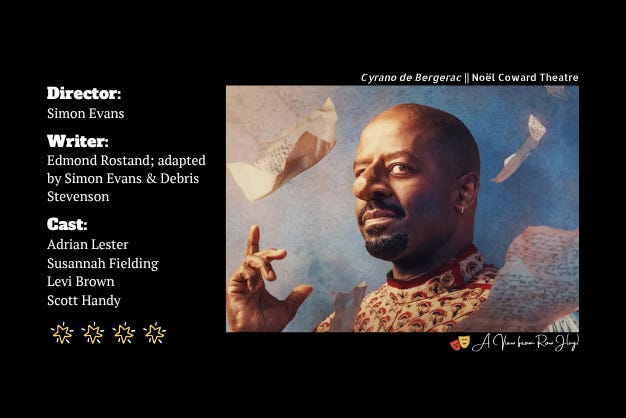
Following a sell-out run at the Royal Shakespeare Company’s Swan Theatre last year, Simon Evans and Debris Stevenson’s adaptation of Edmond Rostand’s classical romance Cyrano de Bergerac, starring Adrian Lester as the eponymous libertine and Susannah Fielding and Levi Brown as Roxane, the love of his life, and Christian, his rival for her love, transfers to the Noël Coward Theatre. Told, retold, adapted, readapted, parodied, translated, relocated and modernised so often that it’s difficult to imagine what, if anything, any production could do to make this material feel fresh, Cyrano de Bergerac is a tale that will be familiar to anyone with even the most tangential interest in culture. Yet Evans and Stevenson’s take on the story, though quite firmly rooted in its classical sensibilities, is stylish and contemporary, playfully tinkering with the dialogue and the narrative while still steadfastly capturing the profundity of Rostand’s explorations of the consequences of love, conflict and death.
Threaded through the original text are ideas of longing and mortality, and how the relentless passage of time makes dust of them both. Cyrano’s desperate yearning to be loved by Roxane goes unspoken because beneath all of his wit, intelligence and bravado lies a deep embarrassment and fear of rejection. Likewise, Roxane’s insistence on language and poetry as the most potent embodiments of romance disguises just how uncomfortable she is with simple, honest emotions. Words pass between them in the form of letters and poems, with Christian in the middle as the feint through which Cyrano expresses himself, yet neither speaks truthfully. All around them the world burns. Men return home from war in coffins and urns, and women and children are widowed and orphaned, yet what terrifies them most, albeit in different ways, is love, a word they both dismiss as inadequate.
It’s a tragic tale, yet one that bristles with whimsy and humanity, and it is this that director Simon Evans captures so beautifully. The staging and direction of his production are vivacious and visually profound - indeed, there is almost as much poetry in the choreography and design of the piece as there is in the dialogue - and the tone and aesthetic of it have a sublime quality that is well contrasted with the levity of much of the humour, particularly in the first half. The theatre space extends into the auditorium as the actors and musicians make use of the main floor, the boxes and the balcony to invite the audience to participate and properly invest in the story, heightening the strength of the emotions that come to the fore in the final act, while musically is cleverly woven into the narrative in the form of a chorus whose melodies uplift and wound in equal measure.
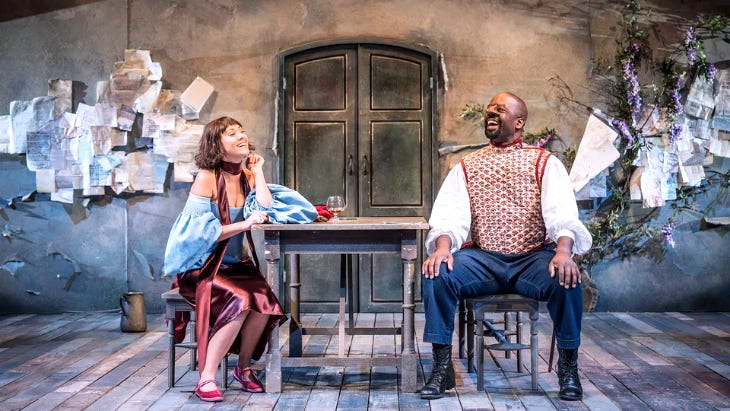
Evans and Stevenson’s adaptation of the text blends Rostand’s verse with modern dialogue but the collocation of the two is thoughtful, creating a flow and a rhythm that feels natural. It’s romantic, of course, but also brutal about the realities of war, death and rejection, and though the jokes are plentiful they are written into the romance so casually and organically that they never detract from the overwhelming yearning that defines so much of the story. The first half is riotous and full of silliness, yet the jokes are warm and inviting and feel very much like an authentic facet of how these characters interact, yet there is also a stoicism and seriousness to it so that the intensity of the romantic feelings is never underplayed or dismissed. Occasionally, the drama lags - both the theatre sequence at the start and the Romeo & Juliet-esque balcony scene are a tad overlong - but the dialogue is so rich and humorous and captivating that this is but a minor concern.
At the heart of the piece are a pair of magnificent performances by Lester and Fielding, both of whom imbue their characters with all the rage, uncertainty, desperation, anxiety and awe requried to make them dazzle. Lester’s Cyrano is utterly captivating, operating as though he is holding court and unveiling his very soul to an audience transfixed by his movements and his eloquence, while Fielding’s Roxane is at once sharp and flighty, marauding the stage like a dancer and engaging in verbal jousts with her wannabe lovers and admirers. The two of them have the most exquisite chemistry - it really does feel as though they have known each other all of their lives - which heightens the lilting romanticism of it all and exacerbates all of its cruel, hopeless tragedy.
Given my familiarity with the narrative, I was surprised by just how much I enjoyed this production, which is by far and away the best adaptation of Cyrano de Bergerac I’ve seen… well, with the possible exception of the highwayman episode of Blackadder the Third, naturally. It’s invigorating, consistently funny and heartbreaking, and the performances, not just from the two leads but from the entire ensemble, are superb. Evans and Stevenson have breathed a new lease of life into a familiar story, riffing on Rostand’s humour and poetry while bringing an inventiveness and sense of adventure to the how it is staged. Delightful stuff.
Tickets for Cyrano de Bergerac are available here.