

Review: Copenhagen
@ Hampstead Theatre until May 2nd 2026

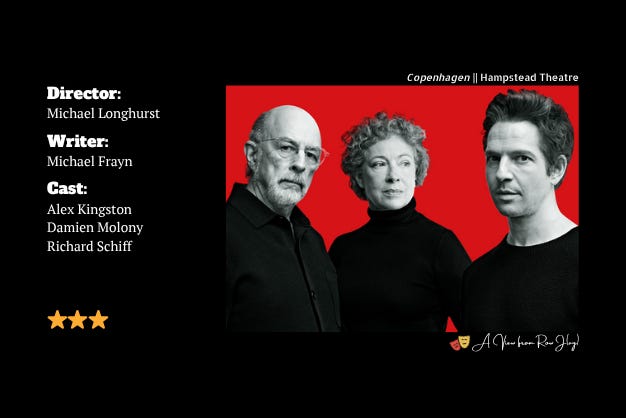
Nazi-occupied Copenhagen, September - or perhaps it’s October - 1941. Danish theoretical physicist Niels Bohr and his wife Margrethe, both of whom are Jewish, receive a visit from old friend and fellow physicist Werner Heisenberg. Heisenberg, who is German, is working on nuclear fission for a Nazi regime currently rampaging through vast swathes of continental Europe. The purpose of his visit and the specifics of his discussion with Bohr that night have been the subject of much debate and disagreement in the decades since and Frayn’s text attempts to construct something resembling an explanation of what might well have been one of the most consequential conversations in all of human history.
Framed as the reflections and memories of the long deceased ghosts of the sole individuals who might truly know what occured on that fateful night, all three of whom have gathered to provide an answer, or rather their interpretation of an answer, Copenhagen explores issues of relativism, whether moral or scientific, collaboration, whether with allies or enemies, and the impossible nature of truth. The metatextuality of the three characters talking to each other in both the past and as spectres who exist outside the mundane confines of time and space allows for a further consideration of the influence of personal experience and beliefs on our perceptions of events, and Frayn takes great delight in attempting to bamboozle the audience with all of these hypotheticals and contradictions.
As with the major theories of the two scientists themselves, there is a fundamental conflict between complementarity and uncertainty in the text. Truth and memory are both obscured when seen through the lenses of hindsight and history, akin to how the behaviour of particles changes the moment we try to observe them, and the perspectives of the different characters become increasingly entangled and confused as they are unable to reflect on the past without being unduly influenced by their understanding of what happened afterwards, as well as their stubborn adherence to their own hypotheses and ideologies.
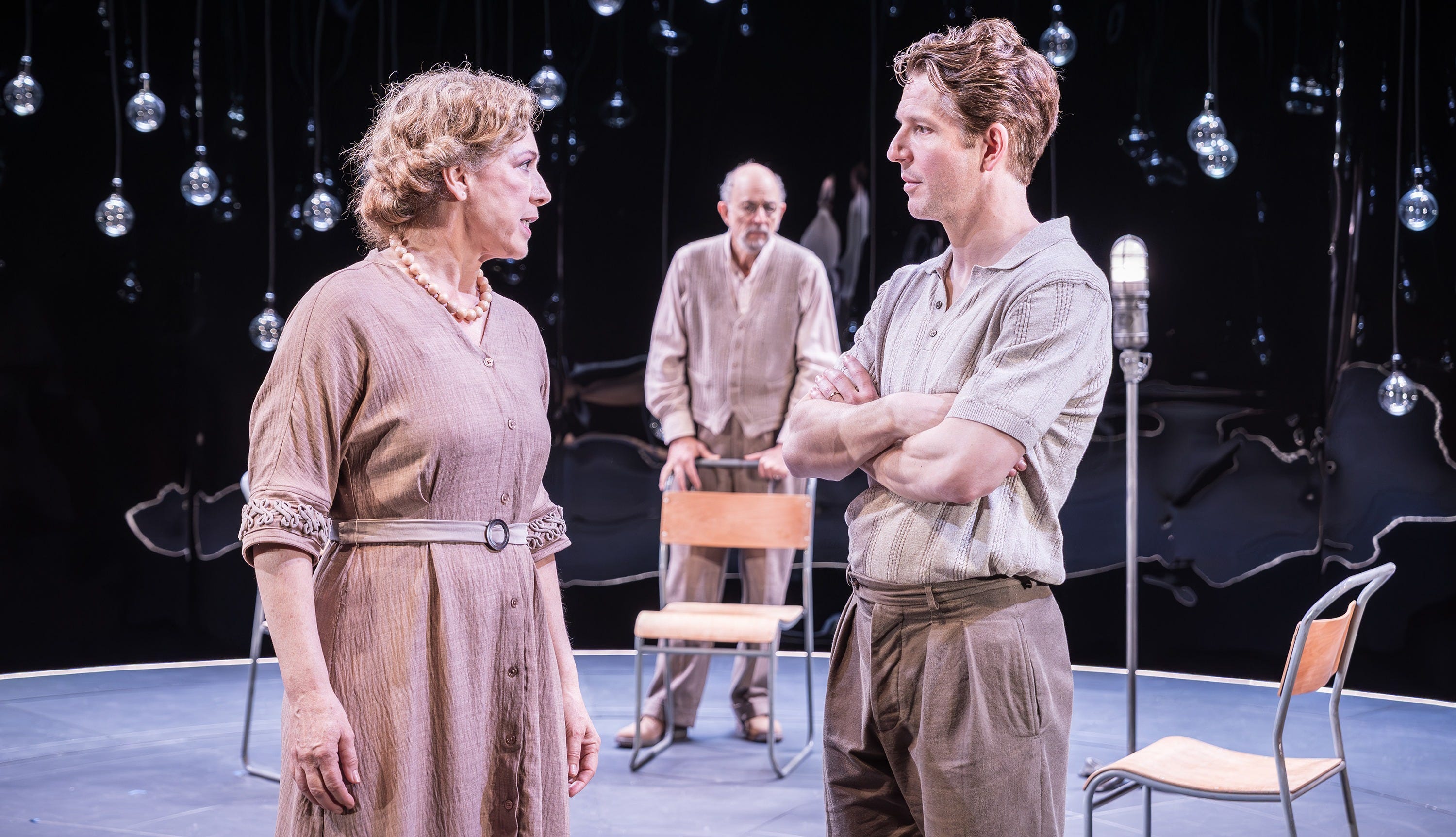
From the verbose and often abstruse back and forth about quantum physics and mathematics to the stage design, which positions the characters on a perfect circle that rotates beneath dim lamps hanging from the ceiling, there’s more than an echo of Carrie Cracknell’s recent production of Arcadia reverberating through this revival of Copenhagen. Indeed, Frayn’s script, which was first written and performed in 1998, feels very Stoppardian in how it blends the personal and the intimate with the philosophical and the theoretical, in how it repeatedly replays and recontextualises moments and conversations of historical significance - a la Travesties - and in how the rational language of science and scientific endeavour is poetically applied to the seemingly irrational emotions and behaviours of human beings. At almost 165 minutes (again, Arcadia would like a word) the play occasionally feels like a trudge through some cerebral battle of the wits, and the first act in particular is rather stodgy in both its exposition and its somewhat cumbersome metaphors.
Alex Kingston, as Margrethe, is given little of anything to do in act one except watch as the two men reminisce, debate and argue, and her performance stumbles as a result, though she thrives in act two when she is finally allowed to confront Heisenberg and, to a lesser extent, Bohr, about their staggering inability to actually understand the world, despite dedicating their lives to trying to do just that. Schiff and Molony are much more consistent throughout because their characters are centered from the very beginning, and act two is a much more astute and accomplished piece of writing than its predecessor, with Frayn effectively wrangling with notions of mortality and of how the greatest minds can so often accomplish the greatest evils. The references to Oppenheimer, the Manhattan Project and the rapid eradication of entire cities on a hitherto unfathomable scale feel more than apt than ever right now, and the production’s occasional subtle fourth wall breaks are rather striking.
I wish act one was either as successful as act two, or at least significantly abridged, and I wish Kingston was given a more prominent role throughout, but there’s far more to commend than to criticise here. Copenhagen poses grand questions about life and death but is never arrogant enough - or perhaps never brave enough - to attempt to provide closure or finality to them, and it’s a thought-provoking play with some moments of real power. It’s also superbly designed by Joanna Scotcher, who deserves real credit for managing to make the stage appear at once minimalist and impossibly grand.