

Review: Care
[Young Vic || May 11th to July 11th 2026]

How the fuck did we get here? This isn’t a rhetorical question. Sure, we all know vicious austerity and the decades-long evisceration of the state have wreaked untold damage to social care services in this country, but how have we, as citizens, children and grandchildren, allowed this to happen? How have we become so blinkered, so utterly disconnected from one another that we accept - and we do accept it, because we’d be stringing the people responsible from lampposts if we didn’t - the parlous state of care in this country? Even if we cannot empathise, how does the terror of growing old and finding ourselves abandoned to a system that is unable to support us not spur us into action?
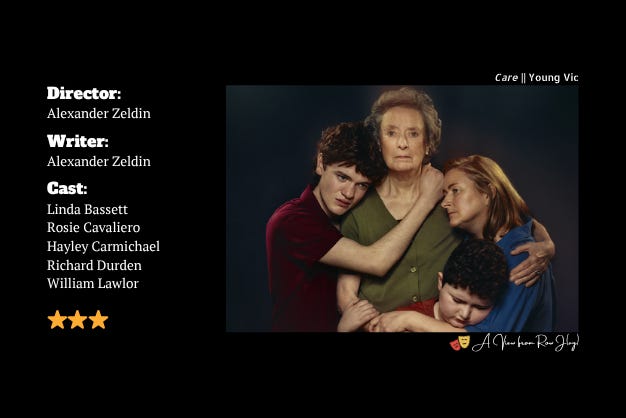
Set in a care home that appears not to have been decorated since the mid-90s and is bedevilled by rolling blackouts and staff shortages, Zeldin’s Care examines the loneliness and isolation experienced by those abandoned to a system that is barely held together by overworked and underpaid nurses. The core focus is on Joan, a new resident who is moved into the home by her struggling family following a fall, and her feelings of despondency as she tries to acclimatise to her new surroundings. Meanwhile, Joan’s daughter and her two young sons try to navigate their guilt at leaving Joan in the throes of a system that cannot sustain itself.
The show’s title refers not just to the profession of social care but also to the act of caring, and the play is a rallying cry to encourage more of the latter. Zeldin wants to engender change within, or at least force a conversation about, the care industry, itself a loaded term that evokes spreadsheets, profit margins and the callous impulses of the market, by compelling us, as passive audience members, to care about the dismal state of things. What it means to care is explored through the nurses, who do their best with what scant resources they have, the family, whose unconditional love for Joan is at odds with their decision to abandon her to a social care system that they can see is crumbling around them, and the residents, for whom care has become a luxury.
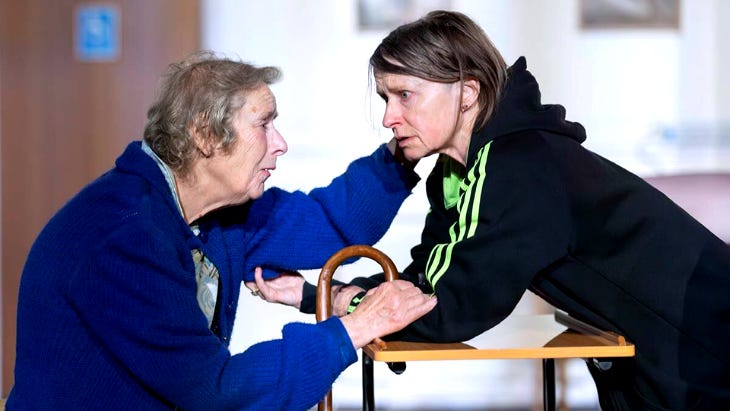
The ensemble of characters, most of whom are in the final stages of their lives, are nicely fleshed out, and Zeldin’s writing is deeply humanistic, though most of them slot a little too neatly into recognisable archetypes, with the home becoming a microcosm. As such, some of the grimy realism of the piece gets lost, and Zeldin is torn between focusing on the family, which is when the text is at its most potent, and what happens in their absence, when people are forgotten, fade away and are quickly replaced like the sheets on the beds in which they died.
The reason this works is that the performances are uniformly excellent. Linda Bassett is remarkable as Joan. Her performance is vulnerable and anguished, and she is the beating heart of the piece. Hayley Carmichael, as a fellow resident and Joan’s friend, likewise delivers a barnstorming performance that is jittery and full of longing, while Llewella Gideon does stellar work as the nurse trying to hold everything together. Credit must also go to William Lawlor, who elevates a somewhat generic teenage miscreant character into something altogether richer and more developed, and his final scene is one of the most impactful in the whole production.
Care is affecting and justifiably excoriating but it’s also oversentimental and manipulative when it doesn’t really need to be. The emotions speak for themselves but Zeldin lays things on a bit too thick at times. As such, it is more a series of powerful vignettes than a tightly woven narrative. Nonetheless, Bassett and Carmichael in particular are superb, and though there are some missteps, it absolutely earns its heartbreaking climax, which is handled expertly by Lawlor.
Tickets for Care are available here.