

Review: A Doll's House
[Almeida Theatre || March 31st to May 23rd 2026]

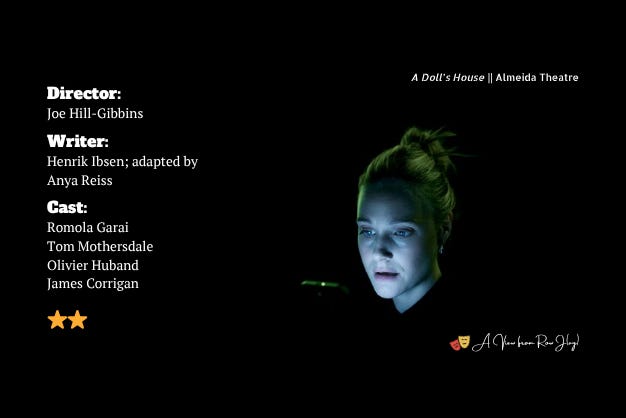
The similarities between Joe Hill-Gibbins’ production of A Doll’s House and Ibsen’s classic text essentially begin and end with the title. Sure, the characters have the same names and the plot generally treads the same, well-worn path but it is, for all intents and purposes, an entirely different play. Though not quite at the level of ChatGPT slop, it does feel as though writer Anya Reiss sat at a computer and thought to herself “do you know what Ibsen needs? Instagram” and then proceeded to forge a tiresome path through TikTok songs and c-bombs, cocaine and finance bros, threesomes and WhatsApp messages and reflections on the follies and evils of Western military interventionism, all while never really concerning herself too much with passé things like dramatic realism or complex characters.
Without wishing to sound like some unreconstructed traditionalist who thinks works of literature are sacrosanct and untouchable or that theatre peaked in the late 19th century, I do think that if contemporary retellings of classic texts are to be worth anything at all, they should be radical. Not superficially radical, in the sense of throwing in a few “fucks” or “cunts” here and there, or setting a dance sequence to a viral tune, but narratively and thematically radical. They should massacre sacred cows, upend and subvert the consensus, and challenge the audience to think in ways that threaten and undermine their cozy middle-class comfort. And, if they do nothing else, they should at the very least draw meaningful parallels between the zeitgeists of then and now.
This production - this “revival”, if we must - does none of that. It’s tame, perfunctory and lacking in emotional heft. It denudes the text of all of its nuance and poetry and, in doing so, reduces these characters to crass, exaggerated stereotypes whose decisions are dictated by an adherence to Ibsen’s essential plot beats rather than by any logic or impulse that constitutes an essential part of who they are. Ibsen’s text is timeless because his characters are complicated. He does not hold them to his own moral standards or judge their actions because he crafts them as real people with real feelings, desires and layers. They do not act in accordance with the story but rather the story is guided by them and all of their contradictions.

By contrast, Reiss’ versions of these same characters are simplistic, bordering on caricaturish. Their behaviour never feels true to who they are because she does not define them much beyond how they compare with Ibsen’s creations. Nora’s decision to leave in the final act - a decision so provocative and revolutionary in 1879, but one that always felt inevitable and true to her character - here feels like some trite afterthought, as though Reiss has been forced to push the character down this path because that’s what the narrative demands. There is no sense of a real woman making a real choice but rather of a writer trying to finagle her way to the conclusion the audience expects. Again, where’s the radicalism? Where’s the sense of newness or subversion? What is the point of this?
There are some pockets of decent work, of course. Romola Garai does all that she can to try to capture what little essence there is to this take on Nora, and her anxious, jittery performance is effective at capturing a woman whose control of her own life is rapidly slipping away from her. The width and breadth of the stage, which is nicely decorated with the shallow symbols of an obscenely capitalist Christmas, well mirrors the chasms that develop between the central characters as the plot progresses, and the final confrontation between Nora and Thorvald, though sloppily written, is well performed by Garai and Tom Mothersdale, both of whom are consistently more convincing than the rest of the ensemble, who struggle to get any real grip at all on their characters or their motivations. Unfortunately, none of this is enough to make the production work.
It is perfectly possible to recontextualise and relocate classic texts without butchering the dialogue or sacrificing who the characters are; just ask anyone who’s ever directed a modern take on Shakespeare. It’s also possible to rewrite and update a classic text without losing its essence. A Doll’s House at the Almeida, alas, fails to do this. Reiss’ script is juvenile and facile and the direction lacks originality. It’s Netflix does Ibsen via the Jamie Lloyd School of Missing the Point, and though it’s sometimes funny and very (very) occasionally thought-provoking, it has nothing to say that Ibsen didn’t say with much more insight and courage almost 150 years ago.
A real shame, this.